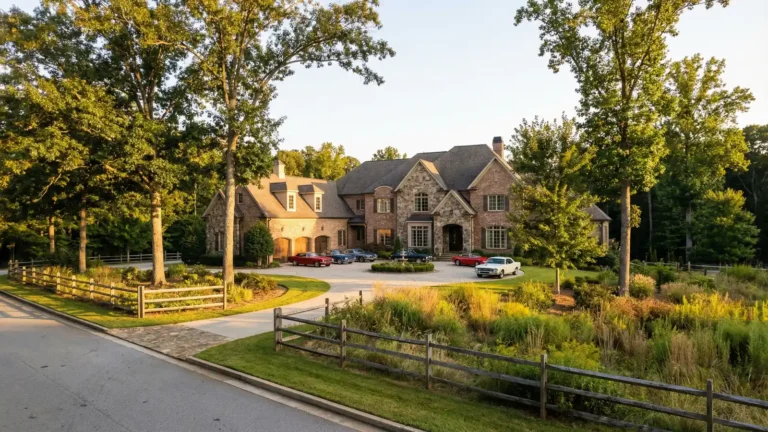
Woodstock GA real estate market: is it worth buying into?

Woodstock GA real estate market: is it worth buying into?
The Woodstock GA real estate market has shifted from afterthought to one of the most closely watched submarkets in Cherokee County. Median sale prices hit $435,000 in Q4 2025, up 7.8% year over year. Days on market compressed to 16, down from 22 in Q4 2024. Active inventory dropped 14% during the same period. Every metric is pointing the same direction.
But metrics only tell you where the market has been. The harder question is whether Woodstock’s current trajectory holds, or whether the city’s rapid appreciation has already priced in the upside.
I’ve been watching Woodstock evolve since the downtown redevelopment started gaining real momentum around 2019. What I’ve seen in the past six years has reshaped how I advise buyers looking at Cherokee County. Here’s the data, the context, and what I think it means for anyone considering buying in Woodstock in 2026.
For how Woodstock compares to its immediate neighbor, read our Woodstock vs Canton breakdown. For the full north Atlanta corridor comparison, start with the north Atlanta suburbs comparison guide.
Current market data
The numbers as of Q4 2025 (sourced from GAMLS and FMLS data):
Median sale price: $435,000, up 7.8% from $403,500 in Q4 2024. Woodstock’s appreciation outpaced Cherokee County’s 5.2% county-wide median gain.
Price per square foot: $185. That’s $17 above the Cherokee County average of $168 and $30 below north Fulton County’s $215. Woodstock occupies a middle position: more expensive than Canton ($168/sq ft) and Holly Springs ($160/sq ft), but accessible to buyers priced out of Alpharetta and Roswell.
Days on market: 16 days average. Twelve months ago, that number was 22. The compression happened primarily in the $375K to $500K range, where inventory turnover is fastest. Homes above $550K sit longer, averaging 31 days.
Active inventory: 118 listings in Q4 2025, down from 137 in Q4 2024. The 14% inventory decline mirrors a broader Cherokee County pattern, but Woodstock’s drop was more pronounced than the county average (-9%).
New construction share: 34% of Woodstock closings in 2025 were new construction, up from 28% in 2024. Builders are capturing a larger slice of the market because resale inventory has tightened.
Distressed sales: Less than 2% of closings involved foreclosure or short sale. This is a healthy market with minimal distress.
Price trends over the past five years
Woodstock’s five-year price trajectory shows consistent appreciation without the volatile spikes that some north Fulton submarkets experienced during the 2021-2022 pandemic surge.
2021: $345,000 median
2022: $385,000 (+11.6%)
2023: $398,000 (+3.4%)
2024: $403,500 (+1.4%)
2025: $435,000 (+7.8%)
The 2023 and 2024 numbers show the interest rate impact. When rates crossed 7% in late 2022, Woodstock’s appreciation nearly flatlined. Buyers pulled back. Inventory accumulated. Then something happened in 2025 that I didn’t see in most other Cherokee County cities.
The downtown investment started producing visible results.
The downtown redevelopment effect
This is the part of the Woodstock story that doesn’t show up in the standard MLS data. You have to drive through the city to see it.
Between 2021 and 2025, the City of Woodstock invested $3.2 million in streetscape improvements along Main Street, added structured parking downtown, and approved zoning for mixed-use development on former industrial parcels east of I-575. Private investment followed. Madlife Stage and Studios opened a 600-seat concert venue. Freight Kitchen and Tap anchored the restaurant corridor. A boutique hotel broke ground on Arnold Mill Road in 2025.
I drove through downtown Woodstock on a Wednesday afternoon in October 2025. Not a weekend. Not an event night. A random Wednesday at 2 p.m. The restaurant patios had diners. The parking deck was two-thirds full. The sidewalk foot traffic looked like a Saturday in downtown Roswell. That wasn’t the case three years ago. Wednesday afternoons in downtown Woodstock used to feel empty.
That shift in daytime foot traffic signals something real estate data alone can’t capture: Woodstock has crossed the threshold from bedroom community to destination city. People drive to Woodstock for dinner now. They didn’t in 2020. When a suburb becomes a destination, property values in the walkable core accelerate faster than the city-wide median.
Neighborhoods within a one-mile radius of downtown Woodstock appreciated 11.2% in 2025 versus 7.8% city-wide. The downtown premium exists and is widening.
New construction pipeline
Cherokee County’s new construction pipeline gives Woodstock a steady flow of new inventory, which prevents the supply constraints that create unsustainable price spikes.

Active builder communities in Woodstock and the immediate unincorporated buffer include Smith Douglas at Towne Mill (townhomes from the mid-$300s, single-family from $430K), Meritage at Trestle Walk (from $425K), D.R. Horton communities along Arnold Mill Road (from $410K), and several smaller infill projects inside the I-575 loop.
The pipeline is healthy but not flooding. Woodstock’s developable land supply is more constrained than Canton’s because the city is more built out. Most new construction in Woodstock comes from infill parcels and rezoned commercial or industrial sites. Canton still has raw farmland converting to residential. That supply dynamic is why Woodstock’s appreciation has outpaced Canton’s over the past three years and is likely to continue.
I track lot release schedules across Cherokee County every month. Builders in Woodstock are releasing lots in smaller batches (8 to 12 lots per phase) compared to Canton communities (15 to 25 lots per phase). Smaller releases mean tighter supply per phase, which supports price stability at each subsequent release. It’s basic supply management, and the builders operating in Woodstock understand the game.
Comparison to Cherokee County averages
Woodstock’s market metrics sit above Cherokee County averages across every category.
| Metric | Woodstock | Cherokee County avg |
|---|---|---|
| Median sale price | $435,000 | $405,000 |
| Price per sq ft | $185 | $168 |
| Days on market | 16 | 21 |
| Year-over-year appreciation | 7.8% | 5.2% |
| New construction share | 34% | 29% |
The gap has been widening for three consecutive years. Woodstock is pulling away from the county average, which tells you the city’s value drivers (downtown investment, walkability, I-575 access, school reputation) are compounding.
Holly Springs, which sits just north of Woodstock on I-575, currently prices 15% to 20% below Woodstock for comparable square footage. Buyers who want the Cherokee County school system and a shorter commute than Canton, but who can’t stretch to Woodstock’s median, should look at Holly Springs as an alternative.
What I’m telling buyers right now
Woodstock is not a speculative bet. The price appreciation is supported by infrastructure investment, employment corridor proximity (the I-575 to I-75 connection puts Woodstock 25 minutes from the Cumberland/Galleria office market), school system credibility, and genuine lifestyle amenity development downtown.
Is Woodstock “cheap”? No. Not anymore. The $345K median from 2021 is gone and not coming back.
The value case for Woodstock in 2026 rests on the spread between Woodstock and north Fulton. Alpharetta’s median sits at $525K. Milton’s at $765K. Roswell’s at $490K. Woodstock’s $435K median puts it $55K to $330K below those cities, and the school system, while not Forsyth County, performs well above the state average. Buyers who need to be in the north metro corridor but can’t justify north Fulton pricing find Woodstock offers 85% of the lifestyle at 75% of the cost.
The risk factor: if interest rates drop below 6% and demand surges across metro Atlanta, Woodstock’s limited land supply could push prices into the $475K to $500K range faster than the income growth in the area supports. That scenario would create an affordability ceiling. I don’t think it happens in 2026, but it’s on my radar for 2027.
For now, Woodstock’s fundamentals are strong, its trajectory is supported by tangible investment, and the pricing gap to north Fulton gives buyers upside room. The buyers who move into Woodstock in 2026 are buying at a higher floor than five years ago, but they’re still buying below the area’s ceiling.
Download the Woodstock market snapshot report
The Woodstock Market Snapshot Report compiles the data from this analysis into a printable three-page reference document. Includes median price trends (five-year), active inventory counts, new construction pricing by community, days on market by price tier, and a Woodstock-to-county comparison table. Updated quarterly.
[Download the Woodstock Market Snapshot Report], name and email required. Arrives in your inbox within 60 seconds.
Where to go from here
For a side-by-side comparison of Woodstock and Canton across lifestyle factors, schools, commute, and lot sizes, read Woodstock vs Canton. For the complete north Atlanta picture, see living in Woodstock. And for buyers evaluating Woodstock against the fastest-growing suburbs in metro Atlanta, our fastest growing suburbs article puts Woodstock in context.
All of these cities are compared in the north Atlanta suburbs comparison guide.
Schedule a consultation at 678-278-9798 to talk through Woodstock’s market position relative to your specific budget and timeline.
—
Written by Itanza Johnson, Managing Broker at Velocity Real Estate. Georgia Tech industrial engineering graduate. Former Division Sales Manager at John Wieland Homes and VP of Sales and Marketing at Stonecrest Homes. $600M+ in cumulative residential sales across metro Atlanta.
Thinking about buying or selling in metro Atlanta?
Velocity Real Estate has closed more than $600M in new construction and resale across 19 metro Atlanta neighborhoods. Start with a conversation, not a commitment.
Book a consultationCall 678-278-9798