Johns Creek GA real estate market: worth the premium?
Johns Creek GA real estate market: worth the premium?
The Johns Creek GA real estate market hit a median sale price of $625,000 in Q4 2025. Alpharetta posted $530,000 in the same period. Milton came in at $715,000 but with significantly larger lots. The question I hear from buyers at least twice a month: is Johns Creek worth paying more than Alpharetta for essentially the same corridor?
The short answer depends on what you are optimizing for. The longer answer requires looking at five specific factors that drive Johns Creek’s pricing above its neighbors, and understanding which of those factors actually matter to your household.
I have sold homes in Johns Creek since my years managing new construction communities for John Wieland Homes, when the area was still unincorporated north Fulton County. The city incorporated in 2006, and the price trajectory since then has been notably consistent. Not explosive. Consistent. That distinction matters more than most buyers realize.
For the full breakdown of how Johns Creek compares across the north Atlanta corridor, start with our north Atlanta suburbs comparison guide.
The schools drive the premium, and the data supports it
Fulton County Schools serves Johns Creek, and the cluster feeding into Johns Creek High School, Chattahoochee High School, and Northview High School ranks among the strongest in the state.
Northview High School posted a 97% graduation rate in 2025 with a CollegeBoard AP participation rate above 72%. Chattahoochee High has maintained a top-10 ranking in Georgia for six consecutive years. Johns Creek High, the newest of the three, has already established nationally recognized STEM and performing arts programs.
These are not just numbers on a GreatSchools profile. The daily experience inside these schools reflects the investment. Class sizes in core subjects average 22 to 24 students. The extracurricular offerings (robotics, debate, competitive math, 15+ varsity sports) operate at a level that requires parental involvement and community funding beyond the school district’s budget. The booster organizations in Johns Creek raise six-figure budgets annually.
For families with school-age children, the school quality is the premium. When I run the numbers for buyers comparing Johns Creek to Alpharetta, the price gap often narrows or disappears when you factor in private school tuition. A family paying $95,000 more for a Johns Creek home to access Northview High avoids $18,000 to $28,000 per year in private school costs per child. Over four years of high school for two kids, that arithmetic favors Johns Creek by a wide margin.
For a deeper comparison of how school districts influence home values in north Atlanta, read our article on school districts and home values.
Safety and city services
Johns Creek has ranked as one of the safest cities in Georgia every year since incorporation. The city’s crime rate per 1,000 residents runs roughly 40% below the Fulton County average and 55% below the metro Atlanta average.
That safety record is partly demographic, partly infrastructure, and partly deliberate city policy. Johns Creek funds its own police department at a staffing ratio above the national average for cities its size. Response times in residential neighborhoods average under five minutes. The city also invested in traffic management systems and park maintenance at a level that most unincorporated areas and some neighboring cities cannot match.
Buyers rarely list “safety” as their first priority when they start searching. But when I ask buyers at closing what surprised them most about their experience, safety and the general feeling of the neighborhood at 9 p.m. on a Tuesday comes up consistently. That intangible shows up in resale value too. Johns Creek properties hold value during market corrections better than most north Fulton communities, and the 2022 rate shock proved it. While some north Atlanta markets saw 8 to 12% price corrections, Johns Creek dipped 4.7% and recovered within two quarters.
New construction supply is limited, and that is by design
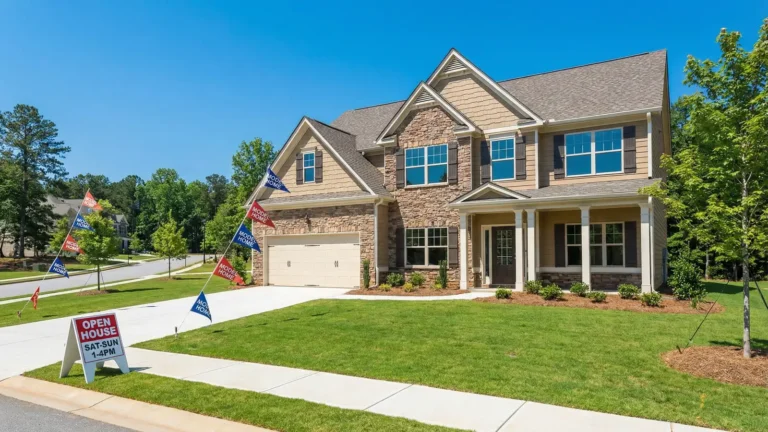
Buyers looking for new construction in the Johns Creek GA real estate market face a supply constraint that Alpharetta and Milton do not share.
Johns Creek is substantially built out. The city’s land use plan prioritizes preservation of existing residential character over high-density development. Rezoning requests for large-scale subdivisions face significant community opposition and city council scrutiny. The result: new construction in Johns Creek comes through infill lots, small-pocket communities of 15 to 40 homes, and redevelopment of older commercial parcels.
Toll Brothers, Ashton Woods, and Edward Andrews Homes have been the most active builders in Johns Creek over the past three years, but their combined annual lot count stays below 120 homes. Compare that to Alpharetta, which permitted over 400 new construction starts in 2025, or Milton, which added 280.
That limited supply does two things. It keeps new construction pricing elevated (starting in the mid-$600s for most builders and reaching $900K or more for custom-lot positions). And it protects resale values for existing homeowners because the market is not absorbing 400 competing new listings every year.
I sold in a Wieland community in what is now Johns Creek back when the lots were $45,000. Those same lots, if you could find one undeveloped (you can’t), would appraise above $200,000 today. The scarcity is real and structural.
The technology corridor factor
Johns Creek sits at the southern end of the GA-400 technology corridor that runs through Alpharetta and into Cumming. Major employers including State Farm (6,000+ employees at its Perimeter-adjacent campus), Alcon Laboratories, and numerous technology firms position Johns Creek as a live-where-you-work option for a segment of the workforce that other suburbs require a longer commute from.

The median household income in Johns Creek exceeds $128,000, which is roughly 65% above the metro Atlanta median. That income base supports the pricing structure and creates a self-reinforcing dynamic: higher incomes fund better city services, better schools receive more volunteer and booster support, and property values reflect the compounding effect.
For buyers employed along the GA-400 corridor, the commute from Johns Creek to the Alpharetta technology parks runs 12 to 18 minutes. To Perimeter Center, it is 20 to 25 minutes. These commute times match or beat Alpharetta-to-Alpharetta drives because Johns Creek’s access points to GA-400 (at Medlock Bridge and Jones Bridge) are less congested than the Highway 9/Old Milton intersections in central Alpharetta.
How Johns Creek compares to Alpharetta and Milton
The three communities share a ZIP code corridor and feed into the same county school system, but they serve different buyer profiles.
Alpharetta offers the broadest price range ($350K to $800K in new construction), the most walkable downtown district (Alpharetta City Center and the Avalon mixed-use development), and the highest volume of new construction options. Buyers who want variety, urban-suburban amenities, and the ability to enter at a lower price point gravitate toward Alpharetta. For the detailed comparison, see our article on Alpharetta vs. Milton.
Milton attracts buyers seeking acreage, equestrian properties, and a rural-suburban blend. Lot sizes averaging a full acre and zoning restrictions that prevent commercial density make Milton the choice for buyers who value land and privacy above walkability and convenience.
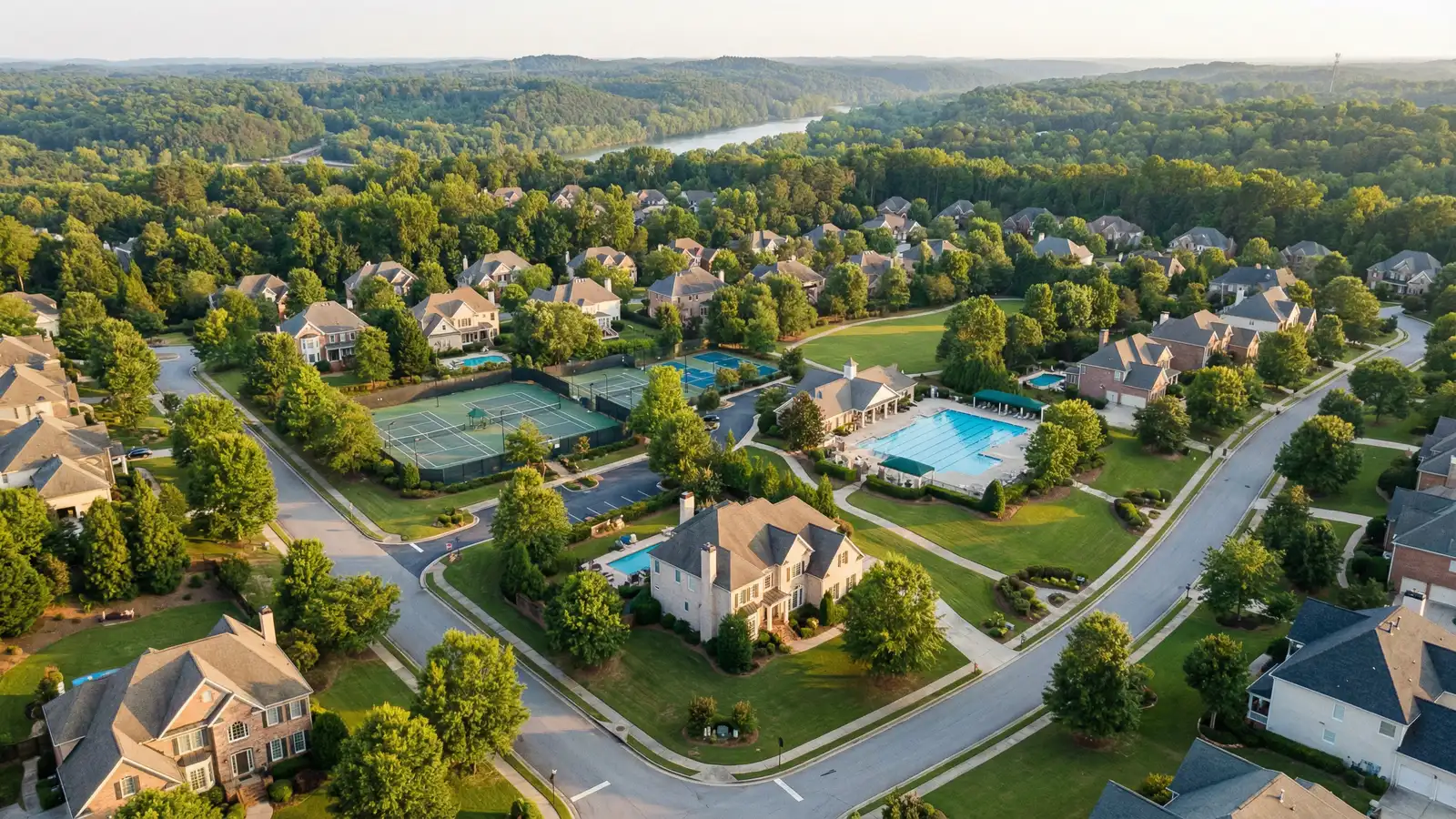
Johns Creek occupies the middle ground: suburban neighborhoods with strong HOA-maintained common areas, excellent schools without the Milton lot premium, and a safety record that gives parents peace of mind. The typical Johns Creek buyer is a family with two working professionals and school-age children who wants a 2,500 to 3,500 square foot home on a quarter-acre to half-acre lot in a neighborhood where the pool, tennis courts, and playground are maintained at a high level.
That buyer profile has remained consistent for 15 years, and it is the consistency of the buyer pool that gives Johns Creek its pricing stability.
Download the Johns Creek buyer guide
The Velocity Real Estate Johns Creek Buyer Guide covers current pricing by neighborhood cluster, school zone assignments with performance data, new construction availability and builder information, HOA fee ranges, and a comparison matrix against Alpharetta and Milton across 10 key factors.
The guide is 4 pages and updated seasonally.
Enter your name and email to download. You will also receive updates when new construction communities launch or significant market shifts occur in Johns Creek.
The verdict depends on your timeline
Johns Creek does not offer the best price per square foot in north Atlanta. It does not offer the most new construction options. It does not have a walkable downtown district to rival Alpharetta’s.
What Johns Creek offers is a combination of school quality, safety, and value stability that compounds over a 7 to 10 year hold. Buyers who plan to stay through the school years and sell when the last child graduates consistently realize strong returns because the next wave of families arrives with the same priorities and the same willingness to pay for them.
For buyers on a three-year timeline or those prioritizing price entry over long-term positioning, Alpharetta delivers more flexibility. For buyers planting roots, Johns Creek earns the premium. Visit our Johns Creek neighborhood page for the full community profile.
—
Written by Itanza Johnson, Managing Broker at Velocity Real Estate. Georgia Tech industrial engineering graduate. Former Division Sales Manager at John Wieland Homes and VP of Sales and Marketing at Stonecrest Homes. $600M+ in cumulative residential sales across metro Atlanta.
Thinking about buying or selling in metro Atlanta?
Velocity Real Estate has closed more than $600M in new construction and resale across 19 metro Atlanta neighborhoods. Start with a conversation, not a commitment.
Book a consultationCall 678-278-9798