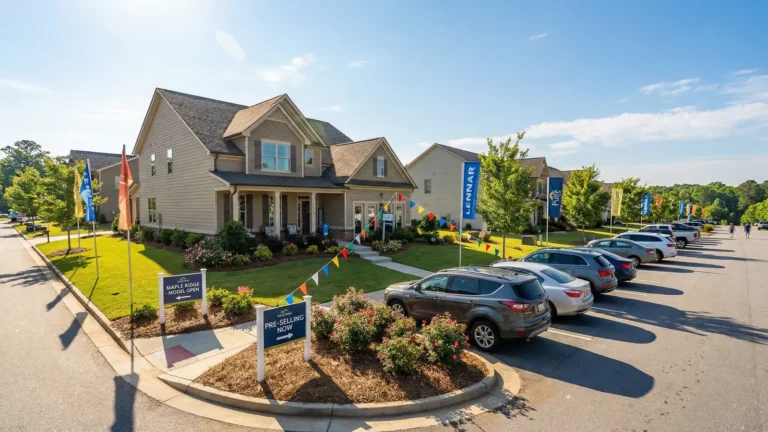
Onsite sales management for home builders

Onsite sales management for home builders
A builder in Cherokee County called me on a Tuesday afternoon last spring. He had 42 finished lots, a model home that had been open for nine months, and a sales pace that had dropped to 1.3 contracts per month. His onsite agent had resigned two weeks earlier. Traffic was still coming through the door (about 18 groups per weekend), but the registration-to-contract conversion rate had fallen to 4.7%. The national average for that price point sits closer to 11%.
He didn’t need a new sales agent. He needed onsite sales management for home builders who understand the full operational system: traffic capture, CRM follow-up cadence, competitive positioning, pricing adjustments, and the weekly reporting that connects showroom activity to closed revenue.
That’s what this article covers. If you’re a builder or developer running new construction communities in metro Atlanta (or anywhere in Georgia), this is a breakdown of what professional onsite sales management includes, why the outsource model produces better results than a single in-house hire, and exactly what Velocity Real Estate delivers when we take over sales operations for a community.
What onsite sales management actually includes
The phrase gets used loosely. Some builders think it means putting a licensed agent in the model home on weekends. That’s staffing, not management. Onsite sales management is a system with seven operational layers that run simultaneously, and every layer feeds data to the others.


Weekly model home coverage. Someone qualified is in the sales office every scheduled hour. They greet traffic, walk the model, present the site plan, explain the product, capture registration data, and set follow-up appointments. This is the visible part. It’s also the smallest part of the job.
Traffic reporting and analysis. Every visitor gets logged. Source of visit, how they found the community, whether they’re working with a realtor, budget range, timeline, product preference, and contact information. Weekly traffic reports break down volume by day, by source, and by buyer profile. Monthly trend lines show whether marketing spend is producing registrations or just impressions.
CRM management and follow-up sequences. Registrations without follow-up are wasted money. The onsite sales management system includes a defined follow-up cadence: same-day thank-you, 48-hour second touch with relevant inventory or incentive information, weekly nurture for active prospects, and monthly check-ins for longer-timeline buyers. I track response rates and appointment-set rates from each sequence.
Competitive shop reports. Every 30 days, the onsite manager visits competing communities within the submarket and documents their pricing, incentive packages, available inventory, lot premiums, and any product changes. This data goes into a comparison matrix the builder uses for pricing decisions. You can’t price in a vacuum. I learned that managing five communities simultaneously for John Wieland Homes, where a pricing change in one Forsyth County neighborhood could shift traffic patterns across three others within the same week.
Pricing recommendations. Based on absorption data, competitive intelligence, traffic trends, and standing inventory levels, the onsite sales manager produces pricing recommendations. These aren’t opinion-based. They’re built from a model that weighs current pace against remaining inventory, time-to-completion on specs, carrying costs, and market-rate comparisons by square footage and lot position.
Realtor outreach and co-op program management. In metro Atlanta, roughly 62% of new construction buyers work with a realtor. Managing that channel means maintaining relationships with the top-producing agents in the submarket, running broker events, and ensuring the co-op commission structure is competitive. Realtor referral tracking is part of the weekly report.
Builder reporting cadence. Everything above flows into a structured reporting package. Weekly flash reports cover traffic count and contract activity. Monthly reports include full competitive analysis, pricing recommendations, marketing channel performance, and pipeline projections. Quarterly reviews cover absorption trends, margin analysis, and strategic recommendations for the next 90 days.
That’s the system. Each layer depends on the others. Traffic reporting without competitive analysis produces incomplete pricing recommendations. CRM management without traffic source data produces generic follow-up that doesn’t convert. The value of onsite sales management is the integration.
Why builders outsource sales operations
The instinct for many builders is to hire a single onsite sales agent, pay a base salary plus commission, and let them handle the model home. I ran that model from the other side of the table for years. Here’s why it breaks down.
A single in-house agent operates in isolation. They see their community’s traffic. They know their inventory. But they don’t have systematic visibility into what competing communities are doing on pricing, incentives, or product changes. They’re not running competitive shops. They’re not benchmarking their conversion rates against submarket averages. When their numbers dip, they often can’t diagnose why because they lack the comparison data.
Turnover is the other problem. The average tenure of an onsite sales agent in metro Atlanta’s new construction market is about 14 months. When that agent leaves, the builder loses their CRM knowledge, their realtor relationships, and their understanding of every prospect in the pipeline. I’ve seen builders lose three to five contracts during a four-week vacancy while they recruit, hire, and onboard a replacement.
The outsource model solves both problems. A professional sales management firm brings a team (not a person), a system (not a personality), and institutional knowledge that stays with the community even when individual team members rotate. The competitive intelligence is baked into the process because the firm manages multiple communities and tracks the entire submarket by default.
When I was VP of Sales and Marketing at Stonecrest Homes, I managed internal sales teams across multiple communities. The operational overhead, including recruiting, training, managing performance, handling turnover, and running competitive intelligence, consumed roughly 30% of my time. Builders who outsource that function get the output without the overhead.
The math works out, too. A fully loaded in-house sales agent (salary, benefits, training, management time, CRM tools, competitive intelligence systems) costs a builder $95,000 to $130,000 annually in the Atlanta market. A professional onsite sales management engagement typically runs 25% to 40% less while delivering more comprehensive reporting and competitive data.
How Velocity structures onsite sales management engagements
Every engagement starts with a community assessment. Before I propose a scope of work, I need to understand the product, the submarket, the competitive set, the builder’s margin targets, and the current sales position. That assessment takes about two weeks and includes a site visit, competitive shop of the five closest communities, traffic and conversion data review (if available), and a pricing analysis against comparable product.
The assessment produces a market position report. That report becomes the foundation for the sales management plan.
The weekly operating rhythm
Monday: review weekend traffic data, update CRM with new registrations, send follow-up sequences. Tuesday through Thursday: prospect follow-up calls and appointments, realtor outreach, competitive intelligence gathering. Friday: prepare weekend sales office, confirm scheduled appointments, update pricing and incentive materials if changes were approved that week. Saturday and Sunday: full model home coverage with traffic capture and registration processing.
That rhythm repeats every week for the duration of the engagement. The consistency matters. Builders who have experienced inconsistent onsite coverage know what happens: traffic arrives, nobody captures it, and the builder pays for marketing that produces zero pipeline.
The monthly reporting package
The monthly report is 12 to 18 pages and covers traffic analysis (total visits, source breakdown, week-over-week trends), pipeline status (active prospects by stage, estimated contract dates, potential cancellation risks), competitive market update (pricing changes, incentive shifts, new community openings, inventory levels at competing projects), absorption rate tracking (current pace vs. plan, projected sellout date at current pace), and pricing and incentive recommendations for the coming 30 days.
I build these reports the way I was trained to build them at John Wieland Homes, where the Division Sales Manager role required presenting absorption data and pricing recommendations to the VP of Sales every month. The format has evolved, but the analytical rigor is the same.
The quarterly strategic review
Every 90 days, the engagement includes a strategic review meeting with the builder’s leadership team. This meeting covers absorption performance against the original pro forma, margin analysis (are we protecting margins or eroding them with incentives?), marketing channel ROI (which spend is producing contracts and which is producing impressions?), product and pricing strategy for the next quarter, and competitive field changes that affect positioning.
The quarterly review is where adjustments happen. Maybe the product mix needs to shift because three-bedroom plans are outselling four-bedrooms 3:1. Maybe the incentive structure needs recalibration because a competitor just increased their closing cost credit by $5,000. Maybe the marketing channel mix needs rebalancing because Google Ads are producing registrations at $47 each while print advertising is running $380 per registration.
The ROI calculation builders need to run
Onsite sales management is a cost. Builders should evaluate it like any other line item. The ROI model I use with prospective builder clients includes four variables.
Incremental contracts. If the current pace is 1.5 contracts per month and professional management lifts that to 2.3 contracts per month (a realistic improvement based on six engagements I’ve managed in the past three years), the incremental revenue on a $450,000 average sale price is $4.32 million annually.
Reduced cancellation rate. Professional CRM management and buyer communication reduce cancellation rates. The average cancellation rate in metro Atlanta new construction is around 18%. Velocity’s managed communities run between 9% and 13%. On a 40-lot community with a $450K average price, reducing cancellations from 18% to 12% saves the builder roughly $1.62 million in re-marketing costs, carrying costs, and price concessions on re-listed inventory.
Faster sellout timeline. Every month a community remains unsold costs the builder in land carry, model home maintenance, HOA subsidies, and opportunity cost on the next project. Accelerating sellout by four to six months through improved conversion rates and strategic pricing can save $200,000 to $500,000 depending on community size and carrying cost structure.
Protected margins. This is the variable most builders undervalue. Without competitive intelligence and disciplined pricing strategy, builders default to reactive discounting. They drop the price $10,000 because a prospect said the home down the street is cheaper. Professional onsite management diagnoses why prospects are comparing (is it actually a price issue, or is it a value-perception issue?) and recommends responses that protect base price while using targeted incentives to close the deal.
Add those four variables together and the ROI on professional onsite sales management typically runs between 8:1 and 15:1. The Onsite Sales Management ROI Calculator walks through these variables with your community’s specific numbers.
What Velocity tracks that most sales operations don’t
Three metrics separate a managed sales operation from a staffed one.
Traffic-to-registration conversion rate. Not every person who walks through the model home signs the guest register. The industry average registration rate is about 65%. Velocity’s managed communities maintain 82% to 88% registration rates because the greeting protocol, sales office layout, and information exchange are designed to make registration feel like a natural part of the visit rather than a data-capture exercise.
Registration-to-appointment conversion rate. Getting someone to register is step one. Getting them back for a second visit or a formal sales appointment is where most onsite operations lose momentum. The follow-up cadence and content (not generic drip emails, but specific inventory updates and incentive notifications relevant to their stated preferences) drive this number. Velocity’s target is 35% registration-to-appointment within 14 days of first visit.
Appointment-to-contract conversion rate. This is where the actual selling happens. An appointment that doesn’t convert usually fails for one of three reasons: pricing objection, product mismatch, or timeline misalignment. The onsite manager needs to diagnose which one it is and respond accordingly. Velocity tracks this by objection type so we can identify patterns and adjust strategy. If 40% of lost appointments cite pricing, that’s a pricing signal. If 40% cite timeline, that’s a production schedule conversation with the builder.
Tracking these three metrics in sequence reveals exactly where the sales funnel is leaking. Most in-house onsite agents track contracts and traffic. The space between those two numbers is where deals die, and it’s where professional management makes the difference.
The competitive intelligence advantage
During my years as Division Sales Manager at John Wieland Homes, I managed communities that competed directly with Toll Brothers, Ashton Woods, and Pulte in the same submarkets. The pricing decisions we made weren’t based on our costs alone. They were based on a weekly competitive intelligence cycle that tracked every active community within a five-mile radius.
That discipline carries into every Velocity engagement. The competitive shop report isn’t a favor or an occasional exercise. It’s a scheduled deliverable. Every 30 days, I visit or have a team member visit the five to eight closest competing communities. We document base prices by plan, lot premiums by position, current incentive packages, available inventory (specs, quick move-ins, to-be-built), estimated traffic levels, and any product or design changes.
This data goes into a rolling comparison matrix. Over six months, patterns emerge. You can see which competitors are increasing pace (and whether it’s through pricing, incentives, or marketing). You can spot when a competitor is entering close-out phase, which changes their pricing strategy and creates an opportunity for your community to capture their overflow traffic. The absorption rate optimization article covers how to use this data to adjust your own pace.
Builders who operate without this intelligence are flying blind on pricing. And pricing is the single highest-leverage decision a builder makes after land acquisition.
When to bring in onsite sales management
Four situations signal that a builder needs professional sales management.
Pre-sales and community launch. The first 90 days of a new community set the pricing trajectory for the entire project. Getting the community launch right, with proper VIP list development, realtor preview events, and opening-weekend execution, requires experienced sales management from day one.
Sales pace below plan. If the community’s absorption rate has dropped below the pro forma projection for two consecutive months, something in the sales system is broken. It might be pricing, marketing, onsite execution, or competitive pressure. Professional management diagnoses the issue and deploys corrections.
Onsite agent turnover. When the builder loses their sales agent and faces a hiring timeline of four to eight weeks, every day without coverage costs traffic and pipeline. Velocity can deploy onsite coverage within one week of engagement.
Close-out phase. The last 20% of inventory requires a different sales strategy than the first 80%. Incentive escalation, realtor bonus programs, and standing inventory marketing all change during close-out. Builders who try to close out a community with the same approach they used during active selling leave money and time on the table.
How builder incentive structuring fits into the sales management system
Incentives are a tool, not a strategy. The onsite sales manager recommends incentive packages based on competitive data, absorption pace, and margin targets. A rate buydown that costs the builder $8,000 per unit might produce a 0.4-unit-per-month increase in absorption. A $12,000 closing cost credit might produce a 0.6-unit increase. The right incentive at the right time is a surgical decision, not a blanket discount.
Velocity’s onsite management includes incentive tracking across the competitive set and monthly recommendations on incentive structure. The builder incentive structuring article breaks down the types, timing, and margin impact of each incentive approach.
Download: onsite sales management ROI calculator {#downloadable}
The Velocity Real Estate Onsite Sales Management ROI Calculator is an 8-page guide that walks builders through the financial case for professional sales management. Inside, you’ll find input fields for your community’s specific numbers (lot count, average sale price, current absorption rate, current cancellation rate, carrying costs), benchmark data from Velocity’s managed communities, a four-variable ROI model you can run with your own assumptions, and a breakeven analysis showing the minimum absorption improvement needed to cover the management fee.
Enter your name and email to download the calculator. You’ll receive it within 60 seconds.
[Download the Onsite Sales Management ROI Calculator]
Where to go from here
If you’re a builder evaluating whether professional onsite sales management fits your current community or upcoming project, the next step is a community assessment. That two-week process produces a market position report with specific recommendations.
Schedule a builder consultation to start the assessment. If you’re still in the research phase, the supporting articles in this cluster cover the specific operational areas that onsite management addresses: builder marketing ROI and traffic generation, absorption rate tracking and optimization, community launch execution, close-out phase management, and incentive structuring strategy.
Each of those articles links back here because onsite sales management is the system that ties all of those functions together.
—
Written by Itanza Johnson, Managing Broker at Velocity Real Estate. Georgia Tech industrial engineering graduate. Former Division Sales Manager at John Wieland Homes and VP of Sales and Marketing at Stonecrest Homes. $600M+ in cumulative residential sales across metro Atlanta.
Thinking about buying or selling in metro Atlanta?
Velocity Real Estate has closed more than $600M in new construction and resale across 19 metro Atlanta neighborhoods. Start with a conversation, not a commitment.
Book a consultationCall 678-278-9798