New construction builder upgrades in Atlanta: what to skip

New construction builder upgrades in Atlanta: what to skip
The design center appointment is where new construction builder upgrades in Atlanta separate disciplined buyers from emotional ones. You walk into a room full of tile samples, cabinet finishes, countertop slabs, and lighting fixtures. Everything is beautiful. Everything has a price tag. And the total at the bottom of the options sheet can climb $40,000 to $80,000 before you finish selecting flooring.
I have sat in design center appointments with buyers at Toll Brothers, Ashton Woods, Pulte, Meritage, and Smith Douglas. The pattern is consistent: buyers overspend on cosmetic upgrades that feel luxurious in the moment and underspend on structural and functional upgrades that actually affect resale value. The markup on some cosmetic options runs 200% to 400% above what you would pay a contractor after closing. Meanwhile, the upgrades that add genuine value to the home, the ones you cannot easily add later, are often buried on page three of the options sheet.
This article covers which upgrades earn back their cost at resale, which ones cost you more through the builder than through a third party, and which ones you should skip entirely. For the full buying process, start with the complete guide to buying new construction in Atlanta.
Upgrades that add resale value: spend here
These upgrades either cannot be done after construction, cost significantly more to retrofit, or directly influence the appraisal value and buyer appeal at resale.
Hardwood or engineered hardwood on the main level
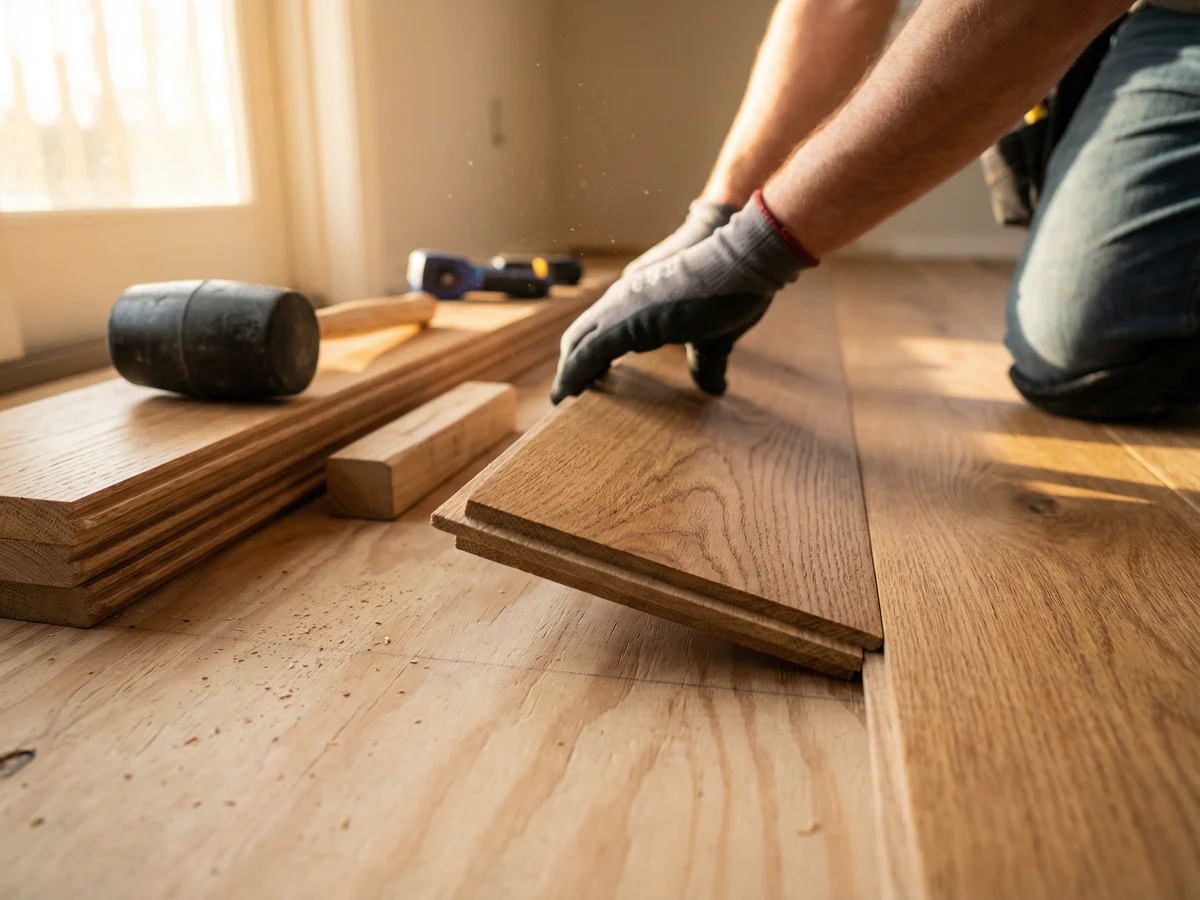
Every resale buyer in the $400,000-plus range in metro Atlanta expects hardwood on the main level. If the builder’s base specification is LVP (luxury vinyl plank), upgrading to 5-inch engineered hardwood on the main level is one of the highest-ROI decisions in the design center.
The builder’s cost for this upgrade typically runs $4,000 to $8,000 depending on square footage. After closing, the same flooring installation costs $8,000 to $14,000 with a third-party contractor because they have to remove the existing flooring, prepare the subfloor, and manage furniture displacement. At resale, hardwood floors on the main level add $10,000 to $15,000 in perceived value in north metro Atlanta’s $450K to $700K range.
I have watched appraisals come in higher specifically because the appraiser noted hardwood on the main level as an upgrade over comparable sales that had LVP. That is real dollar return on a design center decision.
Extended patio or covered outdoor living
In Atlanta’s climate, outdoor living space is used eight to nine months of the year. An extended patio (going from a standard 10×10 builder slab to a 12×20 or larger) costs $3,000 to $6,000 through the builder. After closing, adding a patio with proper grading, drainage tie-in, and HOA approval runs $8,000 to $15,000.
Covered patios and screened porches carry even stronger resale premiums. A screened porch addition after construction costs $15,000 to $25,000 when you factor in structural support, roofline integration, and permitting. Through the builder during construction, the same feature might be $8,000 to $12,000 because the structure is integrated into the original plans.
Gas line to the backyard
A gas stub-out to the backyard for a future grill or fire pit costs $300 to $600 during construction. Running a gas line after the home is built, through a finished wall, under a completed patio, with a plumbing permit, costs $1,200 to $2,500.
This is the single highest ROI upgrade I recommend. Every buyer asks about it at resale.
Electrical pre-wires and rough-ins
Pre-wiring for ceiling fans in bedrooms, a wall-mounted TV in the family room, under-cabinet lighting in the kitchen, and exterior landscape lighting costs $200 to $500 per location during construction. After drywall, running new electrical through finished walls costs $400 to $800 per location plus drywall and paint repair.
A whole-house surge protector pre-wire costs about $150 through the builder. The protection it provides to HVAC systems, appliances, and electronics makes it standard in every options package I review with buyers.
Garage upgrades
A third-car garage bay, if the lot permits it, adds $12,000 to $18,000 through the builder. At resale in communities like those in Johns Creek, Milton, and Alpharetta, a three-car garage is expected in homes above $550,000. Buyers in that range will pass on a two-car garage home in favor of the three-car next door.
Structural shelving, an epoxy floor coating, and electrical for an EV charger are all easier and cheaper to do through the builder than after construction. A 240V outlet for EV charging costs $200 to $400 during rough-in. After closing, the same outlet installation runs $600 to $1,200.
Upgrades with moderate ROI: consider carefully
Kitchen countertops and backsplash
Upgrading from builder-grade granite (level 1) to quartz or a higher-grade natural stone adds $3,000 to $7,000 at the design center. At resale, quartz countertops are expected in the $400K-plus range in most north metro Atlanta communities. The upgrade pays for itself through competitive positioning at resale, but the builder’s markup on countertop material is typically 40% to 60% above retail.

If your budget is tight, select the builder’s mid-range quartz option. The visual difference between mid-range and premium quartz is minimal to the average buyer, and the price gap can be $2,000 to $4,000.
Cabinet hardware and soft-close upgrades
Soft-close hinges and drawer slides are becoming standard specification with many builders in the Atlanta market. If your builder still charges for this upgrade ($600 to $1,200), it is worth adding. Buyers under 45 expect soft-close as standard. Not having it feels dated.
Cabinet hardware is the opposite story. The builder markup on pulls and knobs runs 300% or more. Buy hardware independently on Amazon, Rejuvenation, or Build.com and install it yourself for a fraction of the design center price. A $1,200 hardware upgrade through the builder costs $250 to $400 when you source and install your own.
HVAC zoning
Dual-zone HVAC (separate thermostats for upstairs and downstairs) costs $2,000 to $4,000 through the builder. In a two-story home in Atlanta’s heat, zoned HVAC prevents the upstairs from running 4 to 6 degrees warmer than the main level. Retrofitting HVAC zoning after construction costs $3,500 to $6,000 and involves cutting into ductwork in the attic.
The ROI at resale is moderate. Buyers appreciate it, but it does not show up consistently as a line-item value add in appraisals. I consider it a quality-of-life upgrade more than a financial investment.
Upgrades to skip: save your money
Designer paint colors
Builders charge $2,000 to $5,000 for upgraded paint colors throughout the home. A gallon of Benjamin Moore or Sherwin-Williams paint costs $45 to $75. Painting a 2,500-square-foot home with a local painter costs $3,000 to $5,000, and you get the exact colors you want after seeing the actual light in each room at different times of day.
Choosing paint colors from a design center swatch, under fluorescent lighting, months before the home is finished, is guessing. Choose paint after you move in and see how light hits each room. This is one of the few upgrades where the builder is charging you more for a worse result.
Upgraded door hardware (interior)
The builder’s interior door hardware upgrade costs $800 to $1,500. The same Schlage or Kwikset hardware at Home Depot or Lowe’s costs $200 to $400 for the whole house. Installation takes a screwdriver and 15 minutes per door. Nobody has ever lost a resale because of interior door hardware.
Upgraded light fixtures
Builder light fixture packages look attractive in the design center because the showroom lighting makes everything glow. The markup runs 150% to 300% above retail. A $3,000 lighting package through the builder sources for $800 to $1,200 at online retailers. Your electrician can swap fixtures in a day for $300 to $500 in labor.
The exception: recessed lighting layout changes. If you want additional recessed cans in the kitchen, family room, or master bedroom, add them through the builder. Adding recessed lighting after drywall is installed is expensive and messy. Adding it during rough-in is a minor line item.
Blinds and window treatments
Builders charge $3,000 to $8,000 for basic blinds packages. You can get the same faux wood blinds from SelectBlinds, Blinds.com, or a local installer for 40% to 60% less. Custom window treatments (drapes, motorized shades) are always better sourced independently because you can see the actual light conditions before selecting materials.
The upgrade ROI table
| Upgrade | Builder cost | After-closing cost | Resale value added | ROI rating |
|---|---|---|---|---|
| Hardwood main level | $4,000-$8,000 | $8,000-$14,000 | $10,000-$15,000 | High |
| Extended patio | $3,000-$6,000 | $8,000-$15,000 | $5,000-$10,000 | High |
| Gas line to backyard | $300-$600 | $1,200-$2,500 | $500-$1,000 | High |
| Electrical pre-wires | $200-$500/location | $400-$800/location | Convenience value | High |
| Third-car garage | $12,000-$18,000 | Not feasible | $15,000-$25,000 | High |
| Quartz countertops | $3,000-$7,000 | $4,000-$9,000 | $3,000-$6,000 | Moderate |
| HVAC zoning | $2,000-$4,000 | $3,500-$6,000 | $1,500-$3,000 | Moderate |
| Designer paint | $2,000-$5,000 | $3,000-$5,000 (your choice) | $0 | Skip |
| Interior door hardware | $800-$1,500 | $200-$400 DIY | $0 | Skip |
| Light fixtures | $2,000-$4,000 | $800-$1,700 | $0 | Skip |
| Blinds package | $3,000-$8,000 | $1,500-$4,000 | $0 | Skip |
How to prepare for the design center appointment
The design center trip is where your negotiation with the builder enters its second phase. Base price negotiation happens at contract. Upgrade negotiation happens at the design center.

Before your appointment, request the full options price list. Most builders will email it. Review it at home, on your own time, without the pressure of a design center consultant guiding you toward the premium tier.
Set a total upgrade budget before walking in. I recommend capping upgrade spending at 8% to 12% of the base price for optimal resale positioning. On a $475,000 home, that is $38,000 to $57,000. Focus that budget on the high-ROI structural and functional upgrades first, then allocate remaining dollars to the moderate-ROI cosmetic upgrades.
If you are comparing financing options for your upgrades, the builder lender comparison article explains how your lender choice affects the total amount you can fold into your mortgage versus paying out of pocket.
Your agent should attend the design center appointment with you. I attend every design center session with my buyers because the options consultant works for the builder. Your agent works for you. Those two perspectives in the same room produce better financial outcomes. Browse new homes in Atlanta to see communities where we are actively helping buyers through this process.
—
Download the builder upgrade ROI calculator worksheet
I created a Builder Upgrade ROI Calculator Worksheet that lets you list every upgrade the builder offers, enter the builder’s price, estimate the after-closing cost, and calculate which upgrades deliver the highest return. Bring it to your design center appointment.
Enter your name and email to download the worksheet instantly.
[Download: Builder Upgrade ROI Calculator Worksheet], Name + Email
—
Have a design center appointment coming up? Schedule a design center strategy session with Velocity and we will review the options list before you walk in.
—
Written by Itanza Johnson, Managing Broker at Velocity Real Estate. Georgia Tech industrial engineering graduate. Former Division Sales Manager at John Wieland Homes and VP of Sales and Marketing at Stonecrest Homes. $600M+ in cumulative residential sales across metro Atlanta.
Thinking about buying or selling in metro Atlanta?
Velocity Real Estate has closed more than $600M in new construction and resale across 19 metro Atlanta neighborhoods. Start with a conversation, not a commitment.
Book a consultationCall 678-278-9798