Rent vs. buy in Atlanta: the math for 2026

Rent vs. buy in Atlanta: the math for 2026
The rent vs. buy calculation in Atlanta for 2026 looks different than it did two years ago, and most of the advice floating around online hasn’t caught up. Mortgage rates above 6.5% changed the monthly payment math. Atlanta rents climbing 4.7% year over year changed the rental math. Builder incentive packages worth $12,000 to $25,000 changed the new construction math. And if you’re making this decision using a generic online calculator that doesn’t account for Georgia’s property tax structure, Atlanta-specific insurance costs, or the equity you build from month one, you’re working with incomplete numbers.
This article runs the rent vs. buy comparison for Atlanta in 2026 using real, current figures. No national averages. No hypothetical scenarios. Atlanta rents, Atlanta home prices, Atlanta tax rates.
The monthly cost comparison: renting vs. buying in 2026
Here’s the baseline comparison for a household earning $90,000 annually looking at the two most common scenarios in metro Atlanta.
Renting a three-bedroom apartment in the northern suburbs (Roswell, Alpharetta, Johns Creek):
Average monthly rent: $2,350. That includes nothing beyond the unit. Renter’s insurance adds $15 to $25 per month. Utilities run $180 to $260 depending on the season. No equity. No tax deductions. Annual rent increases in metro Atlanta have averaged 4.7% per year since 2022, which means that $2,350 payment becomes $2,460 next year and $2,576 the year after.
Over five years at a 4.7% annual increase, total rent paid: approximately $157,400.
Buying a $385,000 home in Cherokee or Forsyth County (Canton, Holly Springs, Cumming):
With 5% down ($19,250), a 6.875% mortgage rate, property taxes at 0.92%, homeowner’s insurance at $2,400 annually, and PMI at $145 per month, the total monthly housing payment runs $2,890. That’s $540 more per month than renting.
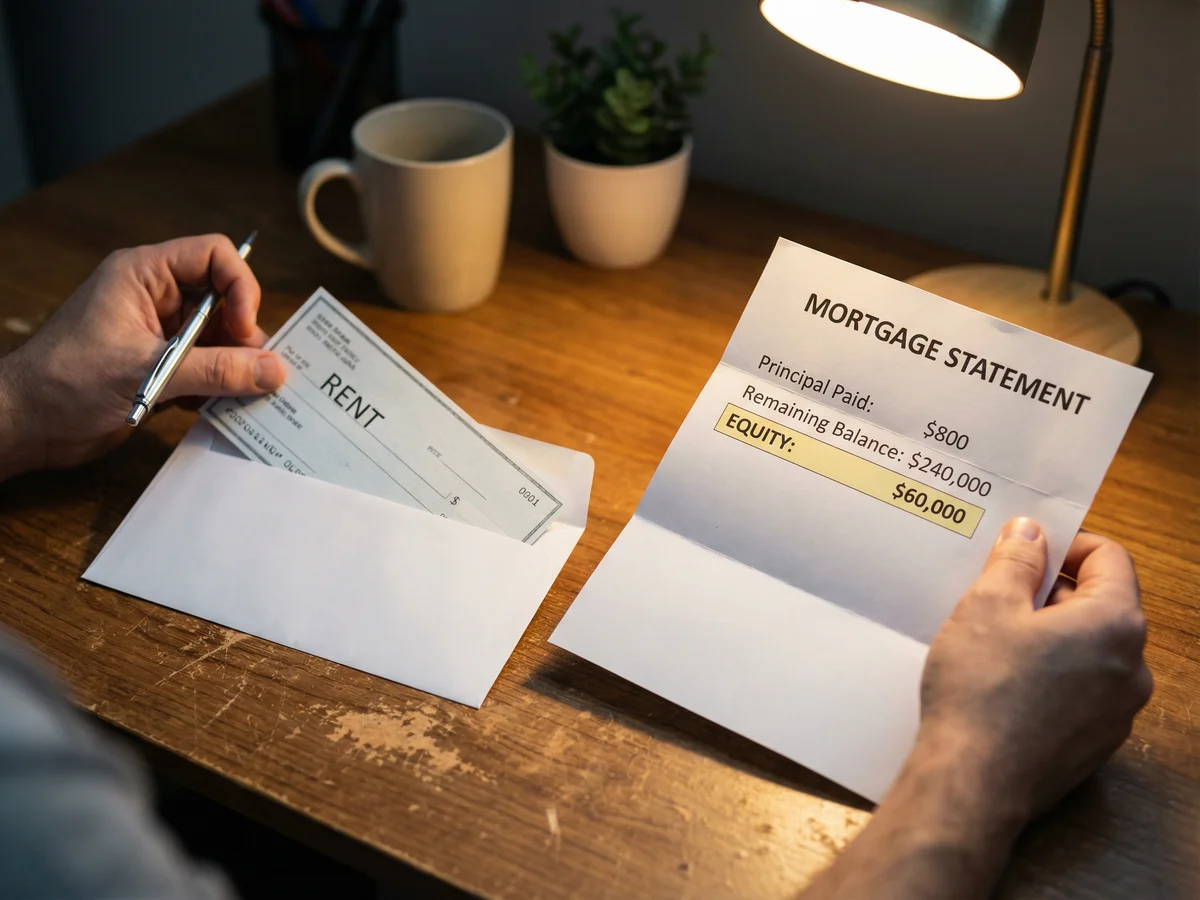
But $680 of that $2,890 goes toward principal from the first payment. You’re paying yourself $680 per month. The renter pays $2,350 per month and keeps none of it.
After one year, the buyer has built $8,280 in equity from principal payments alone, before any appreciation. The renter has built $0.
The five-year breakeven calculation
This is where the numbers get interesting. The question most buyers ask is: how long before buying becomes cheaper than renting? In Atlanta right now, the breakeven point is shorter than most people expect.
Five-year renting scenario:
Total rent paid (with 4.7% annual increases): $157,400. Equity built: $0. Wealth created: negative $157,400 (money spent with no asset to show for it).
Five-year buying scenario ($385,000 home):
Total mortgage payments (P&I, taxes, insurance, PMI): $173,400. Estimated maintenance costs: $19,250 (1% annually). Total closing costs at purchase: $11,550. Total out-of-pocket: $204,200.
Equity from principal paydown after five years: $44,800. Home appreciation at 5.5% annually (conservative for Cherokee/Forsyth counties, which averaged 6.2% over the past five years): $80,400. Total equity position: $125,200 (including the $19,250 down payment).
Net wealth difference after five years: the buyer is ahead by approximately $282,600. That accounts for the $125,200 in equity the buyer holds minus the $0 the renter holds, plus the difference in total housing costs.
The breakeven point, the month where cumulative buying costs including all expenses equal cumulative renting costs plus opportunity cost of the down payment, lands at month 27 in this Atlanta-specific scenario.
By month 28, buying is cheaper than renting on a total-cost basis. And every month after that, the gap widens.
How rate buydowns change the equation
Here’s where the 2026 market creates an opening that didn’t exist in 2023 or 2024. Builders across metro Atlanta are aggressively offering rate buydowns to move inventory, and those buydowns compress the monthly cost gap between renting and buying.
A 2-1 temporary buydown on a $385,000 purchase at a 6.875% base rate works like this: in year one, your effective rate drops to 4.875%, saving $435 per month. In year two, your effective rate is 5.875%, saving $218 per month. The builder pays for this at closing, typically $10,000 to $13,000 depending on loan amount.
With a 2-1 buydown applied, the buyer’s year-one monthly payment drops from $2,890 to $2,455. That’s $105 per month more than renting, not $540. And $680 of that payment still goes to principal.
Some builders in Forsyth and Cherokee County are offering permanent buydowns of 0.75 to 1 full point. A permanent 1-point buydown drops the $385,000 purchase payment to $2,650 per month for the life of the loan. At $2,650, the buyer’s monthly cost is $300 above the renter’s starting rent, but by year two the renter’s escalating rent closes that gap to $185. By year three, the renter is paying more per month than the buyer.
That crossover happens faster than almost any online calculator predicts because those calculators don’t factor in builder incentives. They compare renting at a static price against buying at the listed rate. Neither of those numbers is real.
When renting still makes sense in Atlanta
Buying is not the right answer for every situation, and I’m not going to pretend otherwise. There are real scenarios where renting is the financially sound choice in metro Atlanta right now.
If you plan to stay fewer than two years, the transaction costs of buying and selling (typically 7% to 9% of the sale price when you add agent commissions, closing costs, and transfer taxes) eat most or all of the equity you’d build. The breakeven at month 27 assumes you stay long enough to realize it.
If your credit score is below 620 and you’d be looking at an FHA loan with a high rate plus mortgage insurance that doesn’t drop off (FHA MIP is permanent on loans with less than 10% down), the monthly cost penalty makes renting more efficient while you spend 6 to 12 months improving your credit. That 60-point improvement from 620 to 680 saves $150 per month on a $385,000 mortgage. Six months of work saves $54,000 over the life of the loan.
If you’re mid-career-change and your income documentation won’t satisfy underwriting (new self-employment, job gaps, commission-based income without two years of history), renting gives you time to build the income verification lenders require.
And if you genuinely prefer the flexibility of being able to relocate with 60 days notice, that flexibility has real value. Quantifying it is personal. But renting that flexibility costs $157,400 over five years in Atlanta right now. Only you can decide whether the mobility is worth that price.
The opportunity cost of waiting
One argument for renting is “waiting for rates to drop.” I hear it in consultations regularly. Here’s the math on that strategy.
If rates drop 1 full point (from 6.875% to 5.875%) over the next 12 months and you wait that year to buy, you save approximately $228 per month on the mortgage payment. That’s real savings. But during that year of waiting, you paid $28,200 in rent (money gone), Atlanta home prices appreciated an estimated 5% to 6% ($19,250 to $23,100 on a $385,000 home), and the home you would have bought at $385,000 now costs $404,000 to $408,000.
The net result: you saved $2,736 annually on the mortgage but spent $28,200 in rent and the home costs $20,000 more. You’re $45,000 to $48,000 behind where you’d be if you’d bought today and refinanced when rates dropped.
The Georgia Dream program adds another variable. Qualifying buyers receive $10,000 to $12,500 in down payment assistance. That assistance is available now. There’s no guarantee the program’s funding levels or eligibility thresholds remain the same in 12 months. For buyers who qualify, waiting eliminates a known benefit in exchange for a speculative one.
If you want to explore what the Atlanta price forecast projects for the next 12 to 18 months, that guide covers the supply, demand, and development pipeline data driving the projection.
What the numbers actually say
After running this comparison for hundreds of buyers across metro Atlanta, the pattern holds: for buyers who can stay three years or more, buying at current rates with a builder buydown applied is financially superior to renting. The equity accumulation plus appreciation plus the eventual refinance option (when rates do drop, and they will) creates a wealth-building trajectory that renting cannot match.
The monthly payment on a purchase is higher than rent in year one. Sometimes by $100, sometimes by $400. But each month, a portion of that higher payment builds equity. Every month the renter pays, 100% of that payment disappears.
Over five years, the buyer in metro Atlanta ends up roughly $280,000 ahead. That number shifts based on rate, purchase price, and down payment, but the direction is consistent.
Download: rent vs. buy comparison calculator
The Velocity Real Estate Rent vs. Buy Comparison Calculator is a two-page worksheet that lets you plug in your actual rent, the specific home price you’re considering, your down payment, your rate (with and without a buydown), Atlanta-specific tax rates, and your planned holding period. It runs both the monthly comparison and the five-year total wealth comparison. Fill in the blanks and the answer is on the page.
Enter your name and email to download the calculator instantly.
GHL Tag: Lead: Decision Tool
Where this analysis leads
If you’re a first-time buyer in Atlanta weighing rent vs. buy, our first-time home buyer guide for Atlanta walks through every step from pre-approval to closing. For a personalized rent-vs-buy calculation using your actual numbers, schedule a consultation with Velocity Real Estate at 678-278-9798. We’ll run the analysis with current builder incentives factored in so you see the real comparison, not the generic one.
—
Written by Itanza Johnson, Managing Broker at Velocity Real Estate. Georgia Tech industrial engineering graduate. Former Division Sales Manager at John Wieland Homes and VP of Sales and Marketing at Stonecrest Homes. $600M+ in cumulative residential sales across metro Atlanta.
Thinking about buying or selling in metro Atlanta?
Velocity Real Estate has closed more than $600M in new construction and resale across 19 metro Atlanta neighborhoods. Start with a conversation, not a commitment.
Book a consultationCall 678-278-9798