How much home can you afford in Atlanta?

How much home can you afford in Atlanta?
The gap between what a lender approves and what you can comfortably afford in metro Atlanta is wider than most buyers expect. How much home can I afford Atlanta is the most common question I hear in first consultations, and the honest answer is almost always a different number than what the bank will print on the pre-approval letter. That’s not because the bank is wrong about your qualifications. It’s because the bank doesn’t know you spend $400 a month on youth soccer, daycare costs $1,200 per child, and your car lease resets in 18 months at a higher payment.
This guide breaks down home affordability in metro Atlanta using real income data, actual tax rates, current insurance costs, and the math lenders use versus the math you should use. By the end, you’ll know your comfortable number, not just your maximum.
What Atlanta’s median income actually buys
The Atlanta-Sandy Springs-Roswell MSA median household income for 2025 was $82,400, according to the U.S. Census Bureau’s American Community Survey estimates. The median home price across the five-county metro core (Fulton, DeKalb, Gwinnett, Cobb, Cherokee) hit $415,000 in Q1 2026 per FMLS data.
Here’s how those numbers interact. A household earning $82,400 has a gross monthly income of $6,867. Using the standard 28% front-end DTI ratio, the maximum monthly housing payment (principal, interest, taxes, and insurance) comes to $1,923. At a 7% mortgage rate with 5% down, that supports a purchase price of roughly $310,000 to $325,000.
The median household in Atlanta is qualified for a home that costs $90,000 to $105,000 less than the median home price.
That gap explains why so many buyers feel priced out before they start looking. But the headline number hides important variation. Median income in Forsyth County runs $112,000. In north Fulton (Roswell, Alpharetta, Milton), household incomes average $125,000 to $145,000. Those numbers shift the affordability picture significantly, and the home prices in those areas reflect it.
How lenders calculate what you can borrow
Lenders use two ratios, and understanding both gives you more control over the conversation.
The front-end ratio divides your total monthly housing cost (mortgage principal, interest, property taxes, homeowner’s insurance, HOA fees, and PMI if applicable) by your gross monthly income. Most conventional lenders cap this at 28%, though some will stretch to 31% with strong credit and reserves.
The back-end ratio adds all your other monthly debt payments (car loans, student loans, credit card minimums, personal loans) to the housing cost, then divides by gross monthly income. The conventional ceiling is 43%, though FHA allows up to 50% in some cases and VA loans can go higher.
What those ratios miss: groceries ($800 to $1,100 per month for a family of four in Atlanta), childcare ($1,000 to $1,800 per child depending on the facility and county), health insurance premiums if not employer-covered, retirement contributions, and any savings goals. The lender’s 43% back-end ratio leaves you with 57% of gross income to cover everything else, but after federal and state taxes (Georgia’s income tax is 5.49% on income above $10,000), your actual take-home is closer to 72% of gross. Subtract the mortgage payment, and the margin for everything else gets thin fast.
The number the bank approves vs. the number you should spend
I use a different framework with my buyers. Instead of starting with the maximum approval and working down, we start with their actual monthly cash flow and work up.
Take your net monthly income (after all taxes and deductions). Subtract every recurring expense that won’t change after you buy a home: car payments, insurance, groceries, childcare, subscriptions, savings contributions. What’s left is your true housing budget. That number should cover your mortgage payment, property taxes, insurance, HOA (if applicable), and a maintenance reserve of roughly 1% of the home’s value annually.
For a household earning $95,000 gross in metro Atlanta, the math usually looks like this:
Net monthly income after taxes: approximately $6,175. Subtract recurring non-housing expenses of $3,200 (this is real: two car payments, one student loan, groceries, childcare for one child, utilities at the apartment, insurance). That leaves $2,975 for housing. Subtract $350 for a maintenance reserve on a $420,000 home. Your comfortable monthly housing payment is $2,625.
At a 7% rate with 5% down, $2,625 per month supports a purchase price around $385,000 to $400,000, including taxes and insurance. A lender might approve that same household for $450,000 using the 43% back-end ratio. The $50,000 to $65,000 gap between comfortable and maximum approval is where financial stress lives.
How builder incentives change the affordability equation
This is where buying new construction in metro Atlanta creates an advantage that resale homes can’t match. Builders routinely offer incentive packages that directly reduce monthly payments, sometimes for the entire life of the loan.

The most common incentive structure in metro Atlanta’s new construction market right now: a 2-1 temporary rate buydown. The builder pays a lump sum at closing (typically $8,000 to $14,000 depending on loan amount) that reduces your interest rate by 2 percentage points in year one and 1 percentage point in year two. On a $400,000 purchase at a 7% base rate, a 2-1 buydown drops your payment by approximately $475 per month in year one and $245 per month in year two.
Some builders are offering permanent rate buydowns, paying to reduce the rate for the full 30-year term. I’ve seen permanent buydowns of 0.5 to 1 full percentage point across communities by Pulte, Meritage, and Smith Douglas in Cherokee and Forsyth counties. A 1-point permanent buydown on a $380,000 mortgage saves $228 per month for 30 years. That’s $82,000 in total interest savings.
These incentives don’t appear on Zillow or Realtor.com. They’re negotiated at the sales office, and they change monthly based on the builder’s inventory position and absorption targets. That’s one reason having an agent who tracks builder incentives across communities matters for affordability. We maintain a running comparison of active incentive packages across 40+ new construction communities in our coverage area.
If you’re weighing whether to rent or buy in Atlanta, builder incentives can tip the monthly cost comparison in buying’s favor even at current rates.
Affordability by suburb: where your dollar goes furthest
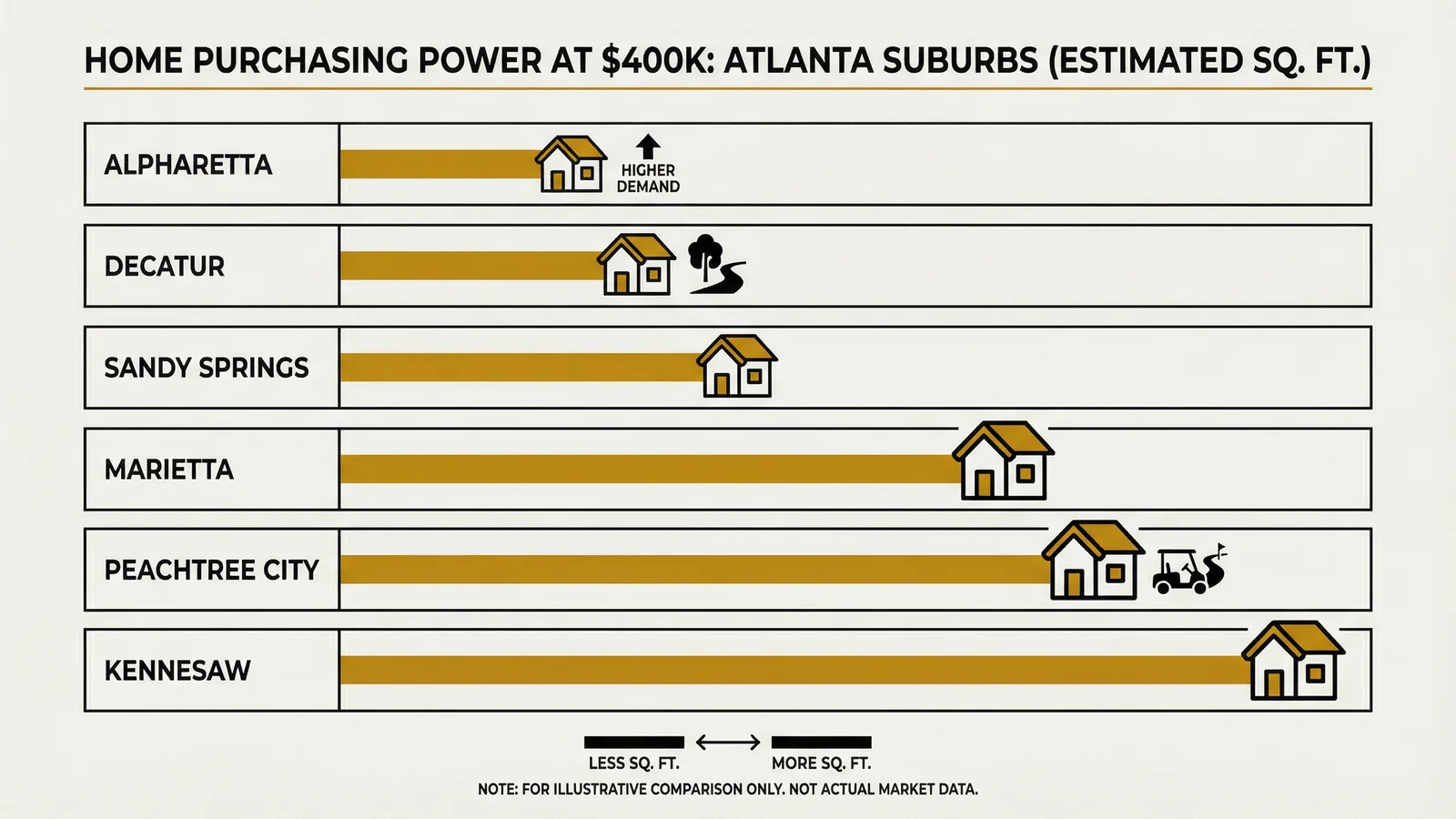
Metro Atlanta’s price variation by submarket is extreme. A buyer’s $400,000 budget buys vastly different homes depending on the ZIP code. Here’s what the same budget looks like across popular first-time buyer suburbs.
| Suburb | Median price (Q1 2026) | What $400K buys | Avg property tax rate | Monthly PITI estimate |
|---|---|---|---|---|
| Canton | $365,000 | 4 bed / 2.5 bath / 2,400 sq ft | 0.92% | $2,680 |
| Woodstock | $395,000 | 3 bed / 2.5 bath / 2,100 sq ft | 0.95% | $2,810 |
| Cumming | $410,000 | 4 bed / 3 bath / 2,600 sq ft | 0.88% | $2,750 |
| Holly Springs | $375,000 | 4 bed / 2.5 bath / 2,500 sq ft | 0.92% | $2,700 |
| Dacula | $370,000 | 4 bed / 2.5 bath / 2,300 sq ft | 1.05% | $2,730 |
| Roswell | $525,000 | 3 bed / 2 bath / 1,800 sq ft | 1.02% | At $400K: townhome only |
| Alpharetta | $520,000 | 3 bed / 2 bath / 1,700 sq ft | 1.01% | At $400K: townhome only |
| Tucker | $355,000 | 3 bed / 2 bath / 1,600 sq ft | 1.15% | $2,650 |
The pattern is clear: the further north and east you go from the city center, the more square footage and lot size your budget covers. Cherokee County (Canton, Holly Springs, Woodstock) and Forsyth County (Cumming) offer the most new construction inventory per dollar for first-time buyers. For a detailed breakdown of commute times, school ratings, and lifestyle differences across these suburbs, see our Atlanta suburbs comparison guide.
The costs buyers forget to budget
Property taxes in Georgia get reassessed when a home sells. The property tax bill you see on Zillow reflects what the previous owner was paying, often with homestead exemptions and a lower assessed value. After you purchase, Fulton County reassesses at fair market value. I’ve seen buyers’ property tax bills jump 40% to 60% in the first full year of ownership after reassessment. On a $400,000 home in Fulton County, that can mean an extra $1,200 to $2,000 annually that wasn’t in the original budget.
Homeowner’s insurance in Georgia has climbed 18% statewide since 2023. The average annual premium for a $400,000 home in metro Atlanta runs $2,100 to $2,800 depending on the county, construction type, and claims history. New construction homes typically insure for less because the roof, electrical, and plumbing are new.
PMI (private mortgage insurance) applies if your down payment is below 20%. On a conventional loan with 5% down on a $400,000 home, PMI runs $125 to $200 per month until you reach 20% equity. That’s an extra $1,500 to $2,400 per year that disappears once you’ve built enough equity, usually five to seven years into the loan at current appreciation rates.
The Georgia Dream factor
For buyers who qualify, the Georgia Dream homeownership program adds $10,000 in standard down payment assistance (or $12,500 for public protectors, educators, and nurses and other healthcare workers, and for households with a member who has an eligible disability; Georgia DCA, effective July 8, 2026). That assistance comes as a second mortgage at 0% interest with no monthly payment, repaid when you sell, refinance, or stop living in the home.
On a $350,000 purchase, $10,000 in Georgia Dream assistance reduces the down payment gap between 5% and 10% by more than half. Combined with a builder’s closing cost credit, some first-time buyers in Canton and Holly Springs are getting into new construction homes with under $8,000 out of pocket.
What a comfortable purchase actually looks like
After running this analysis with hundreds of Atlanta buyers, the pattern is consistent: the comfortable purchase price usually falls 10% to 18% below the maximum lender approval. Buyers who purchase at their maximum report financial stress within the first year. Buyers who stay 15% below their ceiling report stability and the ability to save, travel, and handle unexpected expenses.
A $95,000 household income in metro Atlanta, with typical debt levels and one child, supports a comfortable purchase in the $370,000 to $400,000 range. That budget opens doors in Canton, Holly Springs, Cumming, Woodstock, Dacula, and Tucker for single-family homes, and in Roswell, Alpharetta, and Sandy Springs for townhomes. With builder incentives applied, the monthly payment on a $400,000 new construction home can match or beat a $350,000 resale purchase.
Download: Atlanta home affordability calculator worksheet
The Velocity Real Estate Atlanta Home Affordability Calculator Worksheet walks you through both the lender’s calculation and the comfortable-spending calculation side by side. It includes a section for builder incentive scenarios so you can see how a rate buydown changes your monthly payment. Two pages, printable, with fill-in fields for your specific numbers.
Enter your name and email to download the worksheet instantly.
GHL Tag: Lead: Topic Checklist
The next conversation
If you’re a first-time buyer in metro Atlanta working through affordability, our first-time home buyer guide for Atlanta covers the complete process from pre-approval through closing day. To get a personalized affordability analysis based on your income, debt, and target neighborhoods, schedule a consultation with Velocity Real Estate at 678-278-9798. We’ll run the numbers before you start touring.
—
Written by Itanza Johnson, Managing Broker at Velocity Real Estate. Georgia Tech industrial engineering graduate. Former Division Sales Manager at John Wieland Homes and VP of Sales and Marketing at Stonecrest Homes. $600M+ in cumulative residential sales across metro Atlanta.
Thinking about buying or selling in metro Atlanta?
Velocity Real Estate has closed more than $600M in new construction and resale across 19 metro Atlanta neighborhoods. Start with a conversation, not a commitment.
Book a consultationCall 678-278-9798