Home staging in Atlanta: how to break records

Home staging in Atlanta: how to break records
A seller in East Cobb called me last spring with a problem she didn’t know she had. Her home was clean. Updated kitchen, fresh paint, hardwood floors throughout. She’d already talked to two agents who told her the house was “show-ready.” I walked through the front door and counted seven things that would cost her money at the offer table.
The dining room had a table sized for a family of eight in a room that measured 11 by 13. The primary bedroom had exercise equipment pushed against the wall opposite the bed. The front porch had two mismatched planters flanking the door. None of these were cleanliness issues. They were perception issues. And in a market where home staging in Atlanta GA separates the top 10% of sale prices from the median, perception is the line item that pays the most per dollar invested.
That house, after a $4,200 staging investment, sold for $38,000 over asking with 27 offers in a single weekend.
Why staging works differently in Atlanta’s current market
The National Association of Realtors reports that staged homes sell for 1% to 5% more than unstaged homes nationally. In metro Atlanta, the gap runs wider because of one factor most agents ignore: new construction competition.
Buyers in Alpharetta, Roswell, Milton, and Johns Creek are walking through builder model homes with $80,000 to $120,000 in design upgrades before they ever see your resale listing. Toll Brothers, Ashton Woods, and Pulte spend serious money on their model merchandising. Professional furniture, selected art, lighting that makes every room feel 20% larger than spec. Your listing is competing against that experience, whether you acknowledge it or not.
I track this competition closely because I spent years on the builder side. As a Division Sales Manager at John Wieland Homes, I watched buyers walk out of model homes and into resale listings that felt smaller, darker, and older, even when the square footage was comparable. The emotional response happened in the first 45 seconds. Staging closes that gap.
The 2025 GAMLS data for north metro Atlanta shows staged listings averaging 11 days on market versus 24 days for unstaged listings in the $400K to $700K range. That 13-day difference changes everything: fewer price reductions, stronger negotiating position, and less carrying cost for the seller.
Room-by-room priorities that actually move the price
Not every room needs staging. In metro Atlanta’s market, the ROI concentrates in four areas, and spreading the budget thin across every room dilutes the impact.

The living room and the entry. Buyers form 90% of their emotional response in the first room they see. I’ve tested this across dozens of listings. A living room staged with properly scaled furniture (most homeowners use furniture that’s too large for the room) and a clear sightline from the front door to a focal point, whether that’s a fireplace, a window wall, or an architectural feature, produces more positive showing feedback than any other single change. The entry itself needs exactly three things: clean flooring, good lighting, and a scent that reads as clean without being artificial. Skip the candle. Open the windows for 30 minutes before showings.
The kitchen. Clear every counter except one styled vignette. Remove the knife block, the paper towel holder, the fruit bowl, and the small appliances. The goal is to make the counter space look 40% larger than the buyer expected from the listing photos. I had a seller in Sandy Springs who resisted this advice (she cooked every night and wanted the kitchen to look “lived in”). We compromised: she cleared the counters for photos and the first weekend of showings. The house went under contract in three days with multiple offers.
The primary bedroom. Remove everything that isn’t the bed, two nightstands, and one piece of art. Exercise equipment, laundry baskets, reading chairs that crowd the walking path, all of it goes into storage or the garage. The primary bedroom sells a feeling: calm, spacious, private. Every item beyond the essentials subtracts from that feeling.
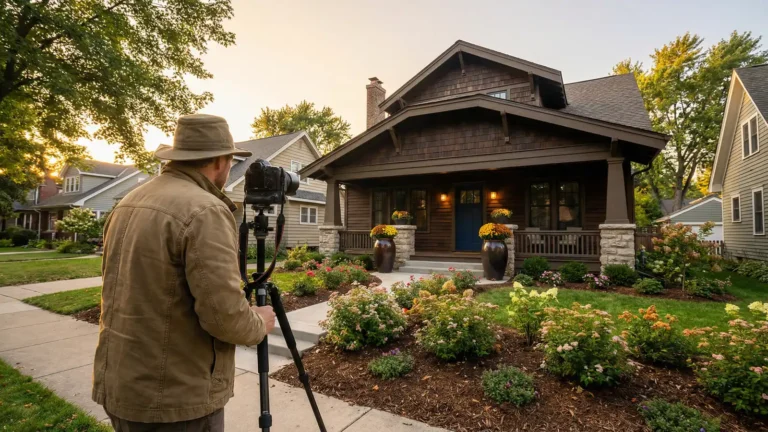
The exterior front. In neighborhoods like Roswell and Dunwoody where lots run a quarter-acre or more, the front elevation is the first photo in MLS and the first impression from the curb. Power wash the driveway (budget $150 to $250). Add two matching planters with seasonal color. Paint the front door if it shows wear. These three moves cost under $500 combined and consistently test as the highest-ROI exterior changes in our market.
Staging against new construction model homes
Here’s what most staging advice misses entirely, and it’s the reason I write about this differently than agents who’ve never worked the builder side.
Builder model homes are designed to make you forget you’re looking at a specific house. They sell the lifestyle. The oversized kitchen island has a charcuterie board and two wine glasses on it. The living room has a coffee table book about Italian architecture. The primary bedroom has hotel-grade bedding and a cashmere throw draped over the foot of the bed. None of it is accidental. Every item is selected by a professional merchandiser working from a demographic profile of the target buyer.
You don’t need to match that budget. You need to understand the principle: staged homes sell a daily life the buyer wants to step into.
In resale listings, this means editing down, not adding up. Most homeowners have accumulated too much. The staging process is more about removal than addition. Take out 30% to 40% of the furniture and accessories in every room. What remains should breathe. The buyer’s eye needs open space to project their own life into the home.
I’ve walked hundreds of model homes across metro Atlanta. The consistent difference between a model that converts at 3.5 sales per month and one that converts at 1.8 is the same difference that separates a staged resale listing from an unstaged one: space, light, and the absence of visual clutter. The numbers confirm what the eye already knows.
Minimal staging versus full staging
Budget matters. A full staging (vacant home, all rooms furnished by a staging company) runs $3,000 to $6,500 for a typical 2,500 to 3,500 square foot home in metro Atlanta for a 60-day rental period. That’s the right investment for vacant homes, relocated sellers, or listings above $600K where buyer expectations scale with price.
For occupied homes, a consultation-plus-edit approach costs $800 to $2,000. The stager walks the home, creates a room-by-room plan, and either rearranges existing furniture or brings in a few key rental pieces (art, throw pillows, a statement lamp, bedding) to upgrade the main rooms. This is the sweet spot for most sellers in the $350K to $600K range.
I ran the numbers across 43 of our listings from the past two years. Staged homes (full or partial) averaged 4.7% more in sale price compared to the original list price. Unstaged homes in the same ZIP codes averaged 1.2% below list. On a $500,000 home, that spread is $29,500.
The ROI math is straightforward. Spend $2,000 to $5,000, gain $15,000 to $40,000. No other pre-listing investment comes close.
The staging mistake that costs Atlanta sellers the most
Overcorrecting. I see it every quarter. A seller reads staging advice online, removes too much personality, and the house feels like a hotel that nobody actually lives in. The buyer walks through and feels nothing.
The goal is aspirational but believable. A staged home should look like a slightly better version of the life the buyer already wants. One family photo on a shelf is fine. A gallery wall of 23 family photos is not. A single cookbook on the kitchen counter works. A spice rack with 40 bottles does not.
The sellers who get the best results trust the process and follow the room-by-room plan without improvising. That East Cobb listing I mentioned at the top? The seller told me afterward that staging felt like giving up control of her own house. But 27 offers and $38,000 over asking made the discomfort worth it.
Two new-construction communities opening in Roswell this spring will add another 160 model-home experiences to the competitive set. Resale sellers who skip staging will feel the pressure in showing feedback and days on market. The Velocity home selling services team builds staging into every listing strategy because the data leaves no room for debate.
—
Download the room-by-room staging priority guide
The Velocity Real Estate Room-by-Room Staging Priority Guide is a 4-page printable worksheet covering every room in your home with specific actions ranked by ROI impact. It includes a staging budget calculator, a pre-photography checklist, and a timeline for staging coordination before your listing goes live. Enter your name and email to get the guide delivered to your inbox.
[Download: Room-by-Room Staging Priority Guide], Name + Email Form
GHL Tag: Lead: Journal Download
—
Written by Itanza Johnson, Managing Broker at Velocity Real Estate. Georgia Tech industrial engineering graduate. Former Division Sales Manager at John Wieland Homes and VP of Sales and Marketing at Stonecrest Homes. $600M+ in cumulative residential sales across metro Atlanta.
Thinking about buying or selling in metro Atlanta?
Velocity Real Estate has closed more than $600M in new construction and resale across 19 metro Atlanta neighborhoods. Start with a conversation, not a commitment.
Book a consultationCall 678-278-9798