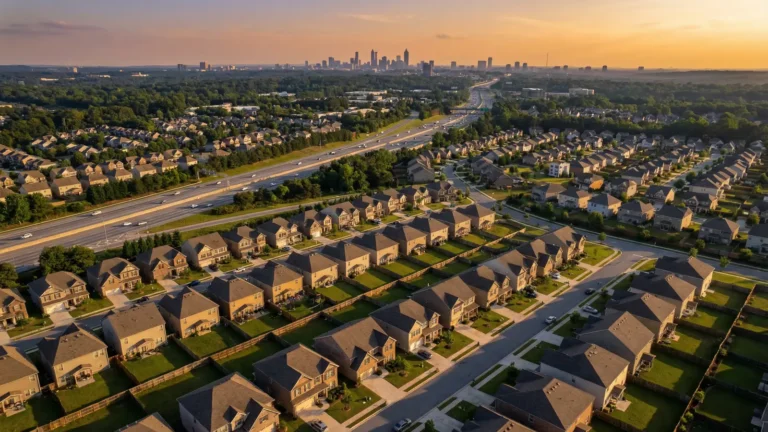
Atlanta’s fastest-growing suburbs in 2026

Atlanta’s fastest-growing suburbs in 2026
The fastest growing suburbs in Atlanta are not the same ones that topped the list five years ago. Cherokee County added 14,200 residents between July 2023 and July 2025, according to U.S. Census Bureau estimates. Forsyth County’s population crossed 280,000 and shows no sign of slowing. But the growth story in 2026 is less about the counties that have been growing for a decade and more about the specific suburbs where new construction permits, school expansions, and commercial development are creating entirely new neighborhoods.
I track building permit data across 22 municipalities in the metro Atlanta region. Every quarter, the pattern shifts. A suburb that issued 180 single-family permits last year might drop to 90 this year because it ran out of developable land. Another suburb that barely registered three years ago might suddenly spike because a major builder acquired 400 acres and broke ground on a master-planned community. The permit data tells you where growth is heading before the population numbers catch up.
This is the ranking for 2026, based on residential building permits issued, population growth rate, infrastructure spending commitments, and new commercial development in the pipeline.
How we rank growth: the four metrics that matter
Population growth alone does not tell you where to buy. A suburb can grow by 3% annually and still feel stagnant if the commercial tax base is not keeping pace. The ranking here uses four weighted factors.
Population growth rate measures the percentage increase in residents over the most recent 24-month Census estimate window. Residential building permits count single-family and townhome permits issued by each municipality (multi-family permits are tracked separately because they indicate rental inventory, not ownership growth). Infrastructure investment captures committed public spending on roads, water/sewer expansion, parks, and school construction within the next 36 months. Commercial development pipeline counts announced or permitted retail, office, and mixed-use projects that signal long-term livability.
A suburb that scores high on all four is genuinely growing. A suburb that scores high on population but low on infrastructure is growing into congestion. That distinction matters when you are buying a home you plan to hold for seven to ten years.
The top suburbs by growth metrics
| Suburb | Pop. growth (2023-2025) | SF permits (2025) | Infrastructure commitment (3-year) | Commercial projects announced |
|---|---|---|---|---|
| Holly Springs | 8.7% | 412 | $94M (road + parks) | 7 |
| Woodstock | 6.2% | 338 | $78M (downtown + roads) | 11 |
| Dacula | 7.1% | 287 | $62M (schools + sewer) | 5 |
| Canton | 5.9% | 356 | $88M (Reinhardt connector + parks) | 9 |
| Tucker | 4.3% | 198 | $55M (Main Street + transit) | 8 |
| Cumming | 4.8% | 425 | $105M (roads + water) | 12 |
Numbers sourced from municipal planning departments, U.S. Census Bureau population estimates, and HUD building permit survey data.

Holly Springs: the suburb that stopped being a secret
Holly Springs issued more single-family building permits per capita than any other suburb on this list. The town’s population sat around 14,000 in 2020. It crossed 17,500 by mid-2025. That kind of growth rate, roughly 8.7% over two years, puts pressure on roads and schools, but Holly Springs has been spending to match.

The $94 million in committed infrastructure over the next three years includes the Sixes Road widening (which has been a bottleneck since 2019), a new 45-acre park complex, and water system upgrades that open an additional 1,200 residential lots for development. Builders have noticed. Toll Brothers, Meritage Homes, and Smith Douglas all have active communities within the Holly Springs planning area.
What makes Holly Springs different from other fast-growing Cherokee County towns is pricing. The median new construction price in Holly Springs sat at $485,000 in Q4 2025. Compare that to Milton at $785,000 or Alpharetta at $625,000. Buyers who are priced out of those north Fulton suburbs (and there are many of them right now) are driving 15 minutes north and finding comparable square footage at 25% to 35% less. For more on how pricing pressure is pushing buyers to new markets, read about suburbs Atlanta buyers are comparing.
I had a relocation buyer from Denver last October who originally targeted Johns Creek. Her budget was $550,000. After we ran the numbers, Johns Creek had exactly three active new construction options under that number, all in communities with fewer than eight lots remaining. We pivoted to Holly Springs. She closed on a 3,400-square-foot home with a three-car garage for $498,000. The commute to her Alpharetta office added nine minutes each way. She has not mentioned Johns Creek since.
Woodstock: downtown reinvention driving residential demand
Woodstock’s growth is anchored by its downtown. The city invested $42 million in downtown redevelopment between 2020 and 2024, and the results show up in foot traffic, restaurant openings, and property values within a two-mile radius of Main Street. The Outlet Shoppes at Atlanta (just south of downtown) draw regional traffic, and the mixed-use developments along Towne Lake Parkway have added walkable retail that did not exist five years ago.
The residential growth story in Woodstock is concentrated in two corridors: the Highway 92 corridor toward Acworth (where builders have access to large tracts) and the area around Towne Lake Hills, where infill development is replacing older inventory. The 338 single-family permits issued in 2025 represent a 22% increase over 2024.
New construction pricing in Woodstock ranges from $420,000 for townhomes to $650,000 for single-family homes on quarter-acre lots. The Woodstock market has tightened considerably since 2023, with days on market dropping from 28 to 16 for new construction priced under $500,000.
Dacula: Gwinnett County’s next growth corridor
Dacula does not get the attention that Suwanee or Buford receive, and that pricing gap is exactly why buyers should pay attention. The median home price in Dacula runs approximately $80,000 below Suwanee for comparable new construction. Gwinnett County schools in the Dacula cluster score competitively with the Suwanee and Peachtree Corners clusters, and the $62 million infrastructure commitment includes a new elementary school and sewer capacity expansion that removes the main barrier to additional residential development.
The Dacula growth story is still in its early chapters. Population growth of 7.1% over two years is strong, but the commercial development pipeline is thinner than Holly Springs or Woodstock. That changes over the next 18 months as two mixed-use projects on Dacula Road come online. Builders positioning in Dacula now are buying land at prices that will not be available in 2028.
Canton: infrastructure spending meets builder inventory
Canton’s growth is a function of two forces colliding. Cherokee County’s population growth has pushed demand north along I-575. At the same time, Canton has committed $88 million to road improvements (including the Reinhardt Parkway connector that will reduce drive time to I-575 by eight minutes from the eastern side of town) and park development.
The builder inventory in Canton is among the largest in north metro Atlanta. At the end of Q4 2025, Canton had 14 active new construction communities with available lots, compared to 6 in Roswell and 4 in Alpharetta. That inventory depth gives buyers negotiating leverage on incentives. I tracked builder incentive packages across Canton communities last quarter and found closing cost credits averaging $12,500, with several communities offering rate buydowns on top of that.
Canton’s challenge is perception. Buyers who work in Midtown Atlanta see Canton as far. The drive is 45 to 55 minutes in peak traffic. But buyers who work in Alpharetta, Roswell, or Kennesaw are 20 to 30 minutes away, and Canton’s pricing makes the math work. New construction median in Canton: $445,000. That same product in Roswell runs $625,000 or more.
Tucker: the DeKalb County outlier
Tucker is the only suburb on this list inside the Perimeter. Its 4.3% population growth rate is modest compared to Cherokee and Forsyth County suburbs, but Tucker’s growth dynamics are fundamentally different. This is infill development and redevelopment, not greenfield master-planned communities.
Tucker incorporated as a city in 2016. Since then, the city has invested in Main Street improvements, trail connectivity, and zoning changes that encourage mixed-use development along Lavista Road. The $55 million infrastructure commitment includes Main Street phase two construction and transit-oriented development planning around the existing MARTA bus network.
What Tucker offers that no other suburb on this list can match is proximity. Tucker sits 15 minutes from Emory, 20 minutes from Midtown, and 12 minutes from I-85. New construction is limited (198 permits in 2025, mostly townhomes and small-lot detached), which keeps pricing elevated relative to the outer suburbs. But for buyers who value a short commute over square footage, Tucker’s median of $475,000 for new construction townhomes represents a strong value compared to $550,000+ for comparable products in Brookhaven or Decatur.
What these growth patterns mean for buyers in 2026
The suburbs growing fastest are not the ones with the lowest prices. They are the ones where infrastructure investment is matching or outpacing residential growth. That balance is what protects long-term property values.
Buyers who focus only on today’s price miss the trajectory. Holly Springs at $485,000 today looks different when you factor in the $94 million in public investment that will reshape the town’s commercial environment over the next three years. Canton at $445,000 looks different when the Reinhardt Parkway connector cuts eight minutes off the commute.
I run a quarterly comparison across all 22 municipalities in our coverage area, tracking these four growth metrics against pricing trends. The suburbs where growth metrics are rising while pricing remains below the metro median are where buyers build the most equity over a five-to-seven-year hold. Right now, Holly Springs, Canton, and Dacula sit in that sweet spot. For a broader view of how these suburbs compare across all major livability factors, see our metro Atlanta real estate market report.
Download the Atlanta growth suburbs comparison guide
The Atlanta Growth Suburbs Comparison Guide puts the full data set into a printable format. It includes all four growth metrics for 15 metro Atlanta suburbs, a pricing comparison table with median prices by home type, school district ratings by cluster, commute time estimates to five major employment centers, and a blank scoring worksheet so you can weight the factors that matter most to your household.
Three pages. Printable. Built for the buyer who wants to compare suburbs with data, not opinions.
Enter your name and email to download the guide.
[Download: Atlanta Growth Suburbs Comparison Guide]
—
Written by Itanza Johnson, Managing Broker at Velocity Real Estate. Georgia Tech industrial engineering graduate. Former Division Sales Manager at John Wieland Homes and VP of Sales and Marketing at Stonecrest Homes. $600M+ in cumulative residential sales across metro Atlanta.
Thinking about buying or selling in metro Atlanta?
Velocity Real Estate has closed more than $600M in new construction and resale across 19 metro Atlanta neighborhoods. Start with a conversation, not a commitment.
Book a consultationCall 678-278-9798