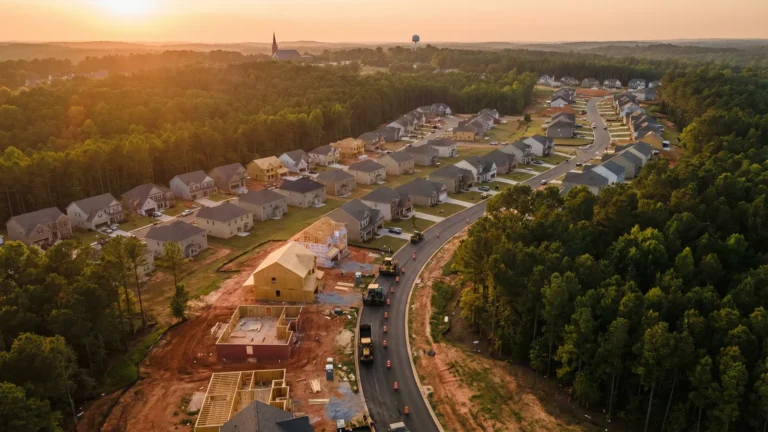
New construction as investment in Atlanta

New construction as investment in Atlanta
Buying new construction as an investment property in Atlanta challenges the conventional wisdom that investors should only buy distressed resale homes. The numbers tell a different story. A new build in Canton or south Forsyth County purchased at $410,000 with a 10-year structural warranty, builder-paid closing costs, and a tenant-ready condition on day one can outperform a $340,000 resale that needs $30,000 in renovations before the first renter moves in.
I’ve run the pro formas on both scenarios dozens of times for investor clients over the past three years. The new construction path produces a lower initial cash-on-cash return (typically 1-3% in year one versus 4-6% for a renovated resale), but the total return over a five-year hold is consistently higher when you factor in lower maintenance costs, stronger tenant retention, and faster appreciation in builder-active submarkets.
The cash flow analysis: a $400,000 new build rental
Let me walk through a real pro forma based on a property I helped an investor purchase in Canton last year. The home was a three-bedroom, 2.5-bath, 1,850-square-foot new construction by Smith Douglas Homes, listed at $398,000.
Purchase price: $398,000. The builder offered a $12,500 closing cost credit and a 1-point rate buydown for using their preferred lender. My client put 20% down ($79,600). The remaining $318,400 was financed at 6.625% (after the buydown) on a 30-year fixed.
Monthly income and expenses:
Gross monthly rent: $2,350 (based on comparable three-bedroom rentals in the same ZIP code, verified through FMLS rental data and Rentometer).
Monthly mortgage payment (principal and interest): $2,038. Property taxes: $298/month ($3,576/year, Cherokee County millage rate). Homeowner’s insurance: $142/month. HOA: $125/month. Property management (8% of gross rent): $188/month. Maintenance reserve (5% of gross rent): $118/month. Vacancy reserve (5% of gross rent): $118/month.
Total monthly expenses: $3,027. Net monthly cash flow: negative $677.
That looks bad on paper. Most YouTube real estate gurus would tell you to walk away.
Here’s what they miss.
The four components of total return
Cash flow is only one of four return components. For new construction investment property in Atlanta, it’s often the smallest piece.

Principal paydown. In year one, $401/month of the mortgage payment goes toward principal. That’s $4,812 in equity building that the tenant’s rent is funding. Your tenant is buying the house for you at a rate of nearly $5,000 per year.
Appreciation. Cherokee County new construction appreciated at 4.3% annualized over the past five years. On a $398,000 home, that’s $17,114 in year one. Over five years with compounding, the home is projected to be worth approximately $491,000.
Tax benefits. Depreciation on the structure ($318,400 structure value divided by 27.5 years) equals $11,578 in annual depreciation. At a 24% marginal tax rate, that saves $2,779 in taxes per year. The mortgage interest deduction adds another $4,950 in tax savings in year one. Total tax benefit: approximately $7,729 in year one.
Cash flow. Negative $677/month in year one, or negative $8,124 annually. But this number improves every year as rents increase and the mortgage payment stays fixed. At 3.5% annual rent growth (conservative for Cherokee County), the property reaches cash flow breakeven in year three and generates $2,400/year in positive cash flow by year five.
Stack all four components for year one: negative $8,124 (cash flow) plus $4,812 (principal paydown) plus $17,114 (appreciation) plus $7,729 (tax benefits) equals $21,531 in total return. On a $79,600 cash investment (down payment), that’s a 27% total return in year one.
Over a five-year hold, the total return on this property projects to $142,000 on an $79,600 investment. That’s 178% total return, or approximately 22.6% annualized.
Find me a stock that does that with a fixed-rate, 30-year financing structure and annual tax shelter of $7,000+.
Why new construction outperforms resale for investors
The gap between new construction and resale investment properties comes down to three factors that don’t show up on a basic cash flow spreadsheet.

Maintenance costs. A new construction home with a builder warranty has near-zero maintenance costs in years one through three. The structural warranty covers the big-ticket items (foundation, framing, roofline) for 10 years. The systems warranty (HVAC, plumbing, electrical) covers years one and two. Appliances carry manufacturer warranties. I’ve seen resale investment properties in the $340,000-$380,000 range require $8,000-$15,000 in maintenance and repairs in the first two years. New construction investors spend close to zero.
Tenant quality and retention. New construction attracts higher-quality tenants who stay longer. My property management contacts report an average tenure of 28 months for tenants in new construction rentals, compared to 18 months for tenants in resale rentals of the same price range in metro Atlanta. Every turnover costs $2,500-$4,000 in vacancy loss, cleaning, touch-up paint, and marketing. Fewer turnovers mean lower real expenses.
Appreciation premium. New construction communities in active-growth submarkets appreciate faster than established neighborhoods with aging housing stock. The builders won’t develop in areas where they don’t project strong appreciation, because their pricing model depends on raising prices as phases sell out. When a builder raises base prices $10,000-$15,000 between Phase 1 and Phase 2, every Phase 1 buyer gets an instant equity bump. Resale homes in older neighborhoods don’t have that pricing tailwind.
Builder incentives and their impact on investor returns
This is where my background in builder operations gives investors an edge that most buyer’s agents miss entirely.
Builder incentives (closing cost credits, rate buydowns, lot premiums waived, free upgrades) directly impact investor returns because they reduce the effective purchase price and the ongoing carrying costs. A $12,500 closing cost credit means $12,500 less cash out of pocket at closing. A 1-point rate buydown on a $320,000 loan saves $165/month for the life of the loan, which is $59,400 in total interest savings over 30 years.
I track incentive packages across 40+ active new construction communities in our coverage area. The incentive environment fluctuates quarterly. In Q4 2025, builder incentives in Cherokee County averaged $14,200 per transaction. In Q1 2024, the same builders offered $8,500. The difference between buying at peak incentives versus low incentives can shift your year-one cash flow by $200+/month.
Timing the purchase to coincide with strong incentive periods is a strategy I deploy regularly with investor clients. Builders increase incentives when traffic slows (typically November through January and during rate spikes). That’s when investors should be buying.
Which Atlanta submarkets work for investors
Not every submarket in metro Atlanta pencils out for new construction investment. North Fulton (Alpharetta, Milton, Johns Creek) has purchase prices that are too high relative to achievable rents. A $650,000 new construction home in Milton might rent for $3,200/month, but the monthly expenses on that property exceed $4,800. The cash flow gap is too wide for most investors.
The submarkets where new construction investment works right now:
Cherokee County (Canton, Holly Springs, Woodstock): purchase prices $370,000-$450,000, rents $2,200-$2,600, appreciation 4.1-4.8% annualized.
South Forsyth County (Cumming, unincorporated Forsyth): purchase prices $385,000-$470,000, rents $2,300-$2,700, appreciation 4.3-5.1% annualized.
Gwinnett County (Dacula, Buford, Lawrenceville): purchase prices $340,000-$420,000, rents $2,100-$2,500, appreciation 3.8-4.5% annualized. Gwinnett offers the lowest entry point and the highest initial cash-on-cash return, but appreciation lags Cherokee and Forsyth by 0.5-1% annually.
Paulding County (Dallas, Hiram): purchase prices $310,000-$380,000, rents $1,900-$2,300, appreciation 3.5-4.2% annualized. Lowest price point in the metro with active builder inventory. Cash flow positive from year one is achievable here, which is rare in the current rate environment.
The five-year hold strategy
I recommend a minimum five-year hold for new construction investment property in metro Atlanta. Here’s why.
Years one and two are the equity accumulation phase. Cash flow is negative or breakeven, but appreciation, principal paydown, and tax benefits compound. The builder warranty covers most maintenance. Tenant retention is high because everything is new.
Year three is the inflection point. Rents have increased enough (at 3-4% annual growth) to push cash flow positive. The property has appreciated $50,000-$70,000. Your equity position has grown from the original $80,000 down payment to approximately $155,000-$175,000.
Years four and five are the harvest phase. Cash flow is solidly positive. Appreciation continues. You now have enough equity to refinance, pull cash out, and use it as a down payment on a second investment property. Or you execute a 1031 exchange into a larger property with better cash flow characteristics.
The investors who build real wealth through new construction in Atlanta are the ones who repeat this cycle every five to seven years, rolling equity forward through 1031 exchanges and compounding their portfolio without triggering capital gains taxes. The real estate wealth building in Atlanta pillar article covers the broader strategy in detail.
Download: new construction investment pro forma template
The Velocity Real Estate New Construction Investment Pro Forma Template is a fillable spreadsheet that models all four return components (cash flow, principal paydown, appreciation, and tax benefits) for a new construction investment property in metro Atlanta. Enter the purchase price, down payment, interest rate, rent, and submarket appreciation rate. The template generates a five-year projection with annual total return calculations.
Inside you’ll also find a builder incentive impact calculator that shows how different incentive packages change your returns, and a submarket comparison table with current price, rent, and appreciation data for six metro Atlanta investor-friendly submarkets.
Enter your name and email to download the template.
[Download the New Construction Investment Pro Forma Template]
Ready to run the numbers on a specific property? Schedule an investor consultation or call 678-809-5860. I’ll pull the builder incentive data, run the pro forma, and walk you through the five-year projection before you make an offer.
—
Written by Itanza Johnson, Managing Broker at Velocity Real Estate. Georgia Tech industrial engineering graduate. Former Division Sales Manager at John Wieland Homes and VP of Sales and Marketing at Stonecrest Homes. $600M+ in cumulative residential sales across metro Atlanta.
Thinking about buying or selling in metro Atlanta?
Velocity Real Estate has closed more than $600M in new construction and resale across 19 metro Atlanta neighborhoods. Start with a conversation, not a commitment.
Book a consultationCall 678-278-9798