New construction community launch playbook

New construction community launch playbook
A new construction community launch playbook determines how a builder’s next 18 to 24 months will play out. I’ve managed community launches where the first weekend produced 11 contracts and launches where the first weekend produced two registrations and a lot of confused looks from the builder’s team. The difference was never the product. It was always the preparation.
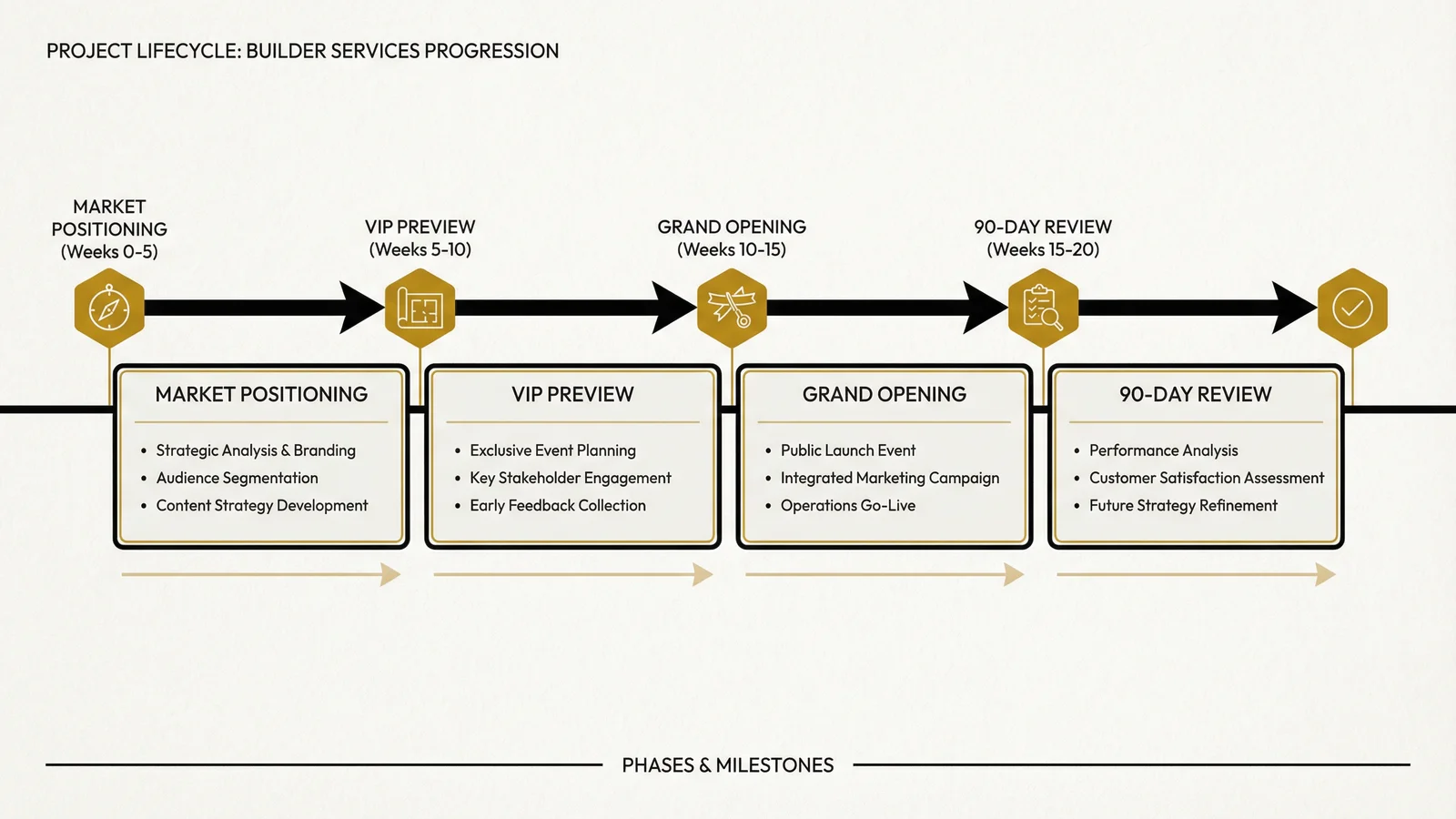
The launch sequence for a new construction community in metro Atlanta runs roughly 16 to 20 weeks from the point the builder decides to move forward on sales to grand opening weekend. Every week in that sequence has specific deliverables. Miss the week-eight milestone and the week-12 event falls apart. This article walks through the full timeline, from VIP list development through grand opening execution, with the benchmarks and decision points I use when managing launches for builder clients.
The pre-sales timeline: week 1 through week 8
Pre-sales begins the moment the builder commits to a sales launch date. In most cases, this happens while the model home is still under construction, site work is ongoing, and the community entrance may not be finished. The pre-sales phase has one objective: build a buyer pipeline large enough to produce contracts on opening day.
Weeks 1 through 2: market positioning and pricing
Before a single prospect hears about the community, the pricing has to be set. This means completing a competitive market analysis of every active community within a five-mile radius, analyzing absorption rates and pricing trends in the submarket, determining base prices by plan and lot premiums by position, and setting the opening incentive package.
Opening-phase pricing is the most consequential decision of the entire project. Price too low and the community sells 15 homes in the first month at margins the builder will spend the next year trying to recover. Price too high and the first phase stalls, which creates a perception problem with realtors and buyers that takes months to overcome.
I approach opening pricing with a framework I developed during my years at John Wieland Homes. The opening base price should sit at 95% to 98% of what the competitive analysis supports as full market value. That 2% to 5% discount creates urgency for early buyers without leaving significant margin on the table. It also gives the builder room for a planned price increase after the first six to eight contracts, which signals momentum to the market.
The opening incentive package follows a similar logic. Offer enough to create a tangible benefit for early buyers (typically $8,000 to $15,000 in closing costs, rate buydown, or design center credits) but structure it to expire after the first phase or the first 10 contracts. The time-limited incentive drives early action without setting a permanent expectation. More on this in the builder incentive structuring article.
Weeks 3 through 4: VIP list development
The VIP list is the pre-launch pipeline. It’s a database of buyers who have expressed interest in the community before it officially opens. A strong VIP list contains 150 to 300 names for a community launch in the Atlanta metro. Of those, 20% to 30% will attend the VIP preview event, and 8% to 12% will contract within 60 days of opening.
Building the VIP list requires simultaneous effort across four channels. First, online registration through a dedicated landing page with the community name, location, price range, expected home sizes, and a “Join the VIP List” form. Drive traffic to this page through targeted Google and social campaigns. Second, realtor pre-registration through a direct outreach campaign to the top 200 agents in the submarket with a specific invitation to register their interested buyers for early access. Third, signage at the community site with a phone number or QR code that connects to the VIP registration page. Fourth, the builder’s existing database, meaning buyers who registered at other communities but didn’t contract, who might match the new community’s profile.
The VIP list isn’t just a headcount. Each registrant should be tagged with source, budget range, timeline, and preferred home type so the follow-up communication can be specific to their situation.
Weeks 5 through 6: realtor preview preparation
The realtor preview event happens one to two weeks before the public grand opening. Its purpose is to get the submarket’s active agents into the community, familiar with the product and pricing, and ready to bring their buyers during opening weekend and the weeks following.
Planning the realtor preview requires confirming the event date and format (lunch works for weekday events, cocktails work for evening events), preparing printed and digital materials (site plan, floor plans, pricing sheet, incentive details, co-op commission structure), setting up the model home for tours (or, if the model isn’t complete, preparing a temporary sales office with renderings and virtual tours), and building the invitation list from the top 300 agents in the submarket by production volume.
A well-executed realtor preview produces 30 to 60 agent attendees. Of those, 10 to 15 will bring a buyer within 60 days. The co-op commission structure presented at this event needs to be competitive. In metro Atlanta, the standard co-op for new construction runs 2.5% to 3%. Some builders offer a bonus (an additional $1,000 to $2,500 per contract) for agents who bring buyers during the first 90 days. That bonus accelerates early referrals.
Weeks 7 through 8: VIP preview event
The VIP preview happens one week before the realtor preview (or the same week, on a different day). This event gives your registered VIP list members first access to the community, first choice of lot selection, and the full opening incentive package.
The VIP event format should feel exclusive but not extravagant. Light refreshments, a structured presentation (15 to 20 minutes covering the community vision, product overview, pricing, and incentive details), followed by model home tours and one-on-one conversations with the sales team.
Targets for the VIP event: 40 to 80 attendees from a list of 200+, 5 to 10 same-day lot reservations (with a $1,000 to $2,500 reservation deposit), and 15 to 25 follow-up appointments scheduled for the week after.
During my time managing launches for Stonecrest Homes, the VIP event was the single highest-converting touchpoint in the entire launch sequence. Buyers who attend a VIP preview convert at roughly 22% to 28% within 90 days. That conversion rate drops to 8% to 12% for buyers who first visit during the public grand opening.
The grand opening: weeks 9 through 12
Grand opening weekend is the public launch. It generates the highest traffic volume the community will see in any single weekend. How that traffic is handled determines whether the pipeline fills or leaks.

Preparing the model home and sales office
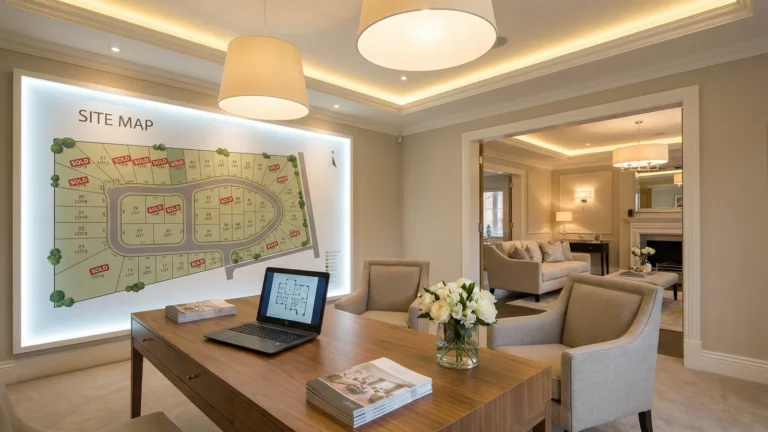
The model home should be fully merchandised (professionally staged with furniture, art, lighting, and landscape) at least one week before grand opening. The sales office needs current pricing sheets, site plans with lot availability marked, incentive package details, financing information from the preferred lender, and registration forms (digital or paper, with source tracking built in).
If the model home isn’t complete (which happens more often than builders like to admit), prepare a temporary sales center with large-format renderings, a video walkthrough of similar completed homes, the full site plan, and a model home completion timeline. Buyers will tolerate an unfinished model if the information is thorough and the sales team is prepared. What kills a launch is an unfinished model with an unprepared team.
Grand opening event execution
Grand opening weekend runs Saturday and Sunday, typically 10 a.m. to 5 p.m. The event should include light catering (keeps people on site longer), activities for children (bounce house, face painting, or similar) if the community targets families, giveaways or raffles for registrants (gift cards are more effective than branded merchandise), and a preferred lender representative onsite for pre-qualification conversations.
Staff the grand opening with at least three sales team members plus the onsite sales manager. Weekend traffic at a well-promoted grand opening can reach 80 to 150 groups. A single agent cannot capture that volume. The registration system must be streamlined enough that every visitor gets logged. The greeting protocol should move visitors through registration, model tour, site plan review, and follow-up scheduling in 30 to 45 minutes per group.
First weekend targets
For a community with 40 to 80 lots in the $350K to $600K range in metro Atlanta, a well-executed grand opening weekend should produce 60 to 120 registrations, 5 to 12 lot reservations or contracts, 20 to 35 scheduled follow-up appointments, and a qualified pipeline of 40+ prospects with confirmed budget and timeline.
If the weekend produces fewer than 40 registrations, the marketing investment was insufficient, the VIP and realtor pre-launch didn’t generate enough momentum, or the community’s pricing and product aren’t connecting with the submarket. Diagnosing which one requires reviewing the marketing channel data from the pre-launch campaign.
The first 90 days after grand opening
The launch isn’t over after opening weekend. The first 90 days establish the community’s absorption trajectory.
Weeks 1 through 4 post-opening
Every registration from the VIP preview, realtor preview, and grand opening enters the CRM follow-up sequence within 24 hours. The follow-up cadence for the first 30 days is aggressive: day-one thank-you with available inventory summary, day-three call or text with a specific question about their timeline, day-seven email with updated lot availability and any new specs under construction, day-14 invitation for a return visit with updated pricing or incentive information, and day-30 check-in with market update.
The onsite agent’s primary job in month one is converting registrations to appointments and appointments to contracts. Weekly traffic reports should show registration-to-appointment conversion rates above 30%. If the rate drops below 20%, the follow-up content or cadence needs adjustment.
Weeks 5 through 12 post-opening
By month two, the community should have a stable absorption rate that can be compared to the pro forma. If pace is at or above plan, hold pricing and begin planning the first price increase (which signals demand to the market and protects early buyers’ equity). If pace is below plan, run the diagnostic: is traffic sufficient? Is conversion lagging? Is there a competitive factor (new community opening nearby, competitor price reduction, rate environment shift)?
The 90-day mark is the first formal strategic review with the builder’s leadership team. This review covers cumulative absorption against plan, traffic source analysis and marketing ROI, competitive field changes since launch, pricing and incentive recommendations for the next quarter, and any product or specification adjustments based on buyer feedback.
Download: community launch timeline template {#downloadable}
The Community Launch Timeline Template is a week-by-week planning document covering the full 20-week sequence from pre-sales kickoff through the 90-day post-opening review. Each week includes specific deliverables, responsible parties, and completion checkboxes. It includes the traffic and conversion benchmarks referenced in this article.
Enter your name and email to download the template.
[Download the Community Launch Timeline Template]
Where this connects
The community launch is the first operational phase of a broader onsite sales management for builders engagement. Once the community is launched and absorbing, the ongoing management system takes over: weekly operating rhythm, monthly reporting, quarterly strategic reviews. For builders preparing a launch, schedule a builder consultation to begin the community assessment.
—
Written by Itanza Johnson, Managing Broker at Velocity Real Estate. Georgia Tech industrial engineering graduate. Former Division Sales Manager at John Wieland Homes and VP of Sales and Marketing at Stonecrest Homes. $600M+ in cumulative residential sales across metro Atlanta.
Thinking about buying or selling in metro Atlanta?
Velocity Real Estate has closed more than $600M in new construction and resale across 19 metro Atlanta neighborhoods. Start with a conversation, not a commitment.
Book a consultationCall 678-278-9798