Living in Milton, GA

Living in Milton, GA
I showed a custom home site in Milton last November to a couple relocating from Buckhead. They had spent 12 years in a 3,200-square-foot colonial on a quarter-acre lot where the neighbor’s kitchen window was close enough to hand over a cup of sugar. The Milton lot was 1.4 acres, bordered by mature hardwoods on three sides, with a creek running along the back property line. The wife walked to the center of the lot, turned around slowly, and said, “I can’t hear a single car.” That moment is Milton in a sentence.
Living in Milton GA means something specific within the metro Atlanta context. It means space. It means equestrian zoning. It means minimum one-acre lots in most residential areas. It means Cambridge High School, one of Georgia’s top-ranked public high schools. And it means a price point that reflects all of those things, with the median home value crossing $850K in 2025 and new construction starting in the low $700s for production builders, climbing well past $1.5M for custom builds on estate lots.
Milton incorporated in 2006, carving itself out of unincorporated north Fulton County specifically to preserve its rural residential character against the commercial and high-density development that was transforming Alpharetta and Roswell. That founding intention still defines the city’s zoning, its growth boundaries, and the type of buyer who chooses it.
Why Milton commands premium home prices
The pricing premium in Milton rests on three pillars: lot size minimums, school quality, and scarcity of available land.
Milton’s zoning ordinances establish minimum lot sizes that start at one acre in most residential districts and go up from there. Agricultural-residential zoning (AG-1), which covers significant portions of the city, allows two-acre minimums and permits equestrian use. These zoning requirements make large-scale, high-density subdivision development impossible within Milton’s city limits. The result is a naturally constrained housing supply.
That constraint shows up in the numbers. FMLS data for 2025 shows 412 total closed single-family sales in Milton for the year. Alpharetta, by comparison, recorded over 1,100. The per-square-foot premium in Milton runs approximately $18 to $25 higher than equivalent construction in Alpharetta, and $40 to $55 higher than Cherokee County communities (Woodstock, Canton). Buyers are paying for the land, the school zone, and the guarantee that the neighborhood’s character is protected by zoning rather than left to market forces.
I tracked a custom build on Freemanville Road that sold at $1.15M in 2024. The home was 4,800 square feet on 1.8 acres, built by a regional custom builder with full brick on four sides. A year later, a comparable spec home two streets over listed at $1.28M and went under contract in 19 days. Milton’s pricing trajectory has been consistent because the supply constraint is structural, not cyclical.
The Crabapple district
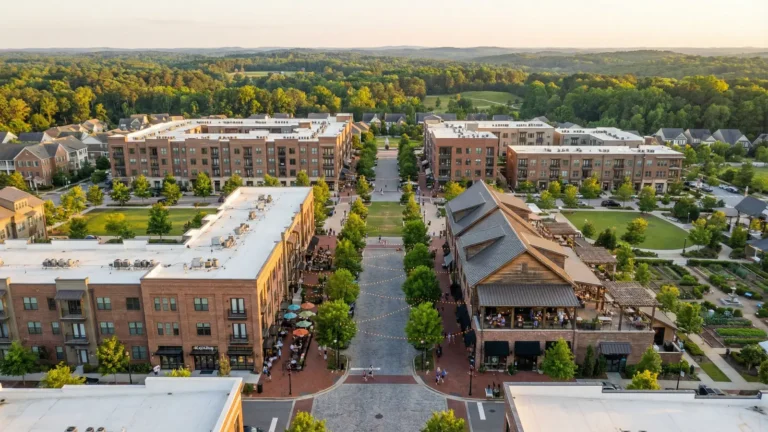
Crabapple is Milton’s center of gravity. The intersection of Broadwell Road, Mid Broadwell Road, and Birmingham Highway (SR 372) forms the heart of what locals call the Crabapple district. The area includes a small commercial village with independent restaurants, a coffee shop, art galleries, and the Crabapple Market, which hosts seasonal events throughout the year.

Crabapple’s character is deliberate. The Crabapple community created design guidelines for commercial development that require traditional architectural styles, brick and stone facades, and limited signage. The result is a village center that looks and feels like a small Georgia town, not a suburban strip mall. No drive-through restaurants. No big-box retail. No neon signs.
The neighborhoods surrounding Crabapple include some of Milton’s most established communities: The Manor at Crabapple (homes from the mid-$600s to $1M+), Crabapple Estates, and several custom home enclaves along Birmingham Highway. Homes within walking distance of Crabapple’s village center carry a 5% to 8% premium over similar homes elsewhere in Milton, based on closed sales data from 2024-2025.
For buyers who want Milton’s space and school quality but also want a walkable commercial core within reach, the Crabapple area delivers both. The trade-off: the most desirable Crabapple-area lots have been built on. New construction near Crabapple is primarily infill (custom homes on remaining vacant parcels) or teardown-rebuilds, both of which carry higher per-lot costs.
Schools in Milton: the Cambridge High School cluster
Cambridge High School is the reason many families choose Milton over every other suburb in metro Atlanta. The school, located on Cogburn Road at the boundary between Milton and Alpharetta, consistently ranks in the top five Georgia public high schools by U.S. News, Niche, and GreatSchools. Cambridge offers an International Baccalaureate (IB) diploma program, 30+ Advanced Placement courses, and a STEM pathway that feeds into Georgia Tech and other engineering-focused universities at an above-average rate.
Cambridge’s 2024-2025 metrics: 96.4% four-year graduation rate, average SAT score of 1230 (170 points above the Georgia average), and 78% of graduates meeting the college-ready benchmark. The school’s student body is approximately 2,200 across grades 9-12.
The Cambridge feeder pattern includes Northwestern Middle School and Hopewell Middle School, with elementary schools including Birmingham Falls, Cogburn Woods, and Crabapple Crossing. Each of these elementary schools holds ratings of 8/10 or above on GreatSchools, with several at 9/10.
One detail that surprises relocating buyers: the Cambridge High School attendance zone includes parts of both Milton and northern Alpharetta. Buyers who want the Cambridge zone but prefer Alpharetta’s pricing and lot sizes can find it in neighborhoods north of Windward Parkway. The zone boundary does not follow the Milton-Alpharetta city line precisely, so verification with Fulton County Schools is essential.
A broader comparison of school districts across north Atlanta suburbs covers every high school cluster in the area, including test scores, program offerings, and feeder patterns.
The equestrian lifestyle and acreage homes in Milton
Milton is one of the few cities inside the I-285 perimeter’s commute shed that allows and encourages equestrian use. The AG-1 zoning district permits horses, and several neighborhoods in Milton are specifically designed around equestrian amenities: riding trails, boarding facilities, paddock-ready lots, and community equestrian centers.

The equestrian community is concentrated in western and northern Milton, along Freemanville Road, Bethany Road, and the areas north of Cogburn Road. Lot sizes in these areas range from 1.5 acres to 5+ acres. Homes on equestrian-zoned lots range from $800K for older ranch-style homes on two acres to $2.5M+ for custom estates with barns, riding rings, and direct trail access.
Birmingham Road (SR 372) runs through Milton’s horse country and connects to a network of unpaved roads and equestrian trails maintained by the city and the Milton Equestrian Conservancy. Weekend mornings along Birmingham Road, you will see riders on horseback alongside the road. It is a visual that feels out of place 35 miles from downtown Atlanta, and that incongruity is exactly what Milton homeowners are protecting through their zoning decisions.
Not every Milton buyer cares about horses. But every Milton buyer benefits from the equestrian zoning because it prevents the land fragmentation and high-density development that would erode lot sizes, increase traffic, and change the community’s character. The equestrian overlay is, functionally, a density cap.
New luxury construction communities in Milton
New construction in Milton falls into two categories: production luxury (builders like Toll Brothers, Ashton Woods, and Edward Andrews Homes offering plans from $700K to $1.2M on lots of one acre or slightly less) and custom builds (individual lots purchased separately, with a custom builder constructing to the buyer’s specifications at $250+ per square foot).
Production luxury new construction
Toll Brothers maintains an active presence in Milton with communities that typically feature 40 to 80 lots, minimum one-acre sizing, and base prices starting in the low $800s. Ashton Woods has built in Milton’s Crabapple-adjacent areas with plans starting in the mid-$700s. Edward Andrews Homes, a regional Atlanta builder, has produced communities in Milton with four-sided brick homes starting around $900K.
These production luxury communities sell at a measured pace. Absorption rates in Milton’s production luxury segment run 2 to 3 homes per month, compared to 4 to 6 per month for production builders in Cherokee County. The slower pace reflects the higher price point and the narrower buyer pool. The advantage for buyers: less urgency, more time to evaluate, and occasionally more negotiating room on design center selections and lot premiums.
Custom homes on estate lots
The custom home market in Milton operates differently from the production model. Buyers purchase a lot (either vacant land or a teardown property) and hire a custom builder to construct a home to their specifications. Lot prices in Milton range from $250K for a one-acre parcel in a less central location to $500K+ for prime acreage near Crabapple or along the equestrian corridors.
Custom build costs in Milton run $250 to $400 per square foot depending on specifications, materials, and builder tier. A 5,000-square-foot custom home on a 1.5-acre lot can reach $1.8M to $2.5M all-in (lot plus construction). The process takes 12 to 18 months from contract to completion and requires significantly more buyer involvement in design decisions, material selections, and construction oversight.
I sat with a buyer couple last summer who had budgeted $1.4M for a custom build in Milton. After we mapped the lot options, builder costs, and the timeline, the total came to $1.65M. The gap was driven by lot prices (they underestimated by $80K) and the cost of the site work (Milton’s terrain is hilly, and grading a sloped lot adds $30K to $60K). Custom builds in Milton require a budget buffer of 15% to 20% above initial estimates.
For buyers considering luxury new construction in Milton, Alpharetta, and north Atlanta, the service page details Velocity’s approach to luxury buyer representation and builder evaluation.
Milton vs. Alpharetta: how they compare
The two cities share a border and a school district but feel fundamentally different. Alpharetta has density, walkability, and commercial infrastructure. Milton has space, quiet, and a deliberate resistance to commercial development.

Price comparison (2025 medians): Alpharetta median home price $575K, Milton median $850K. The gap narrows when you compare on a per-square-foot basis ($185/sqft in Alpharetta vs. $203/sqft in Milton), because Milton’s homes tend to be larger. But lot size is the real differentiator. The average lot in Milton runs three to four times the size of the average lot in Alpharetta.
Commute comparison: Alpharetta sits closer to the GA-400 on-ramp in most neighborhoods, giving it a 5-to-10-minute commute advantage to Perimeter and Midtown. Milton’s western neighborhoods (Freemanville, Birmingham) add 10 to 15 minutes of secondary road driving before reaching GA-400.
Commercial access: Alpharetta has Avalon, downtown, multiple grocery stores, and full commercial services within city limits. Milton has Crabapple’s small village, a Publix on Deerfield Parkway near the Alpharetta border, and the commercial offerings along Highway 9 on Milton’s eastern edge. Milton residents do most of their shopping and dining in Alpharetta (a 10-to-15-minute drive) or in Cumming.
The Alpharetta vs. Milton comparison provides a side-by-side analysis with pricing data, school comparisons, and commute maps.
What it’s actually like to live in Milton
On a Tuesday morning in Milton, the roads are quiet by 8:30 a.m. The school bus routes wind through neighborhoods where the houses sit 100 feet or more from the street. The sound landscape is birds, wind through mature trees, and the occasional horse trailer rattling down Birmingham Road. The gas station at the Crabapple intersection has a hand-painted sign. The coffee shop inside the Crabapple Market knows regulars by name.
Living in Milton requires comfort with distance. The nearest Target is in Alpharetta, 12 minutes away. The nearest Home Depot is on Windward Parkway, 15 minutes. A pediatrician appointment means driving to Alpharetta or Cumming. Milton is not a city of convenience. It is a city of intentional inconvenience: the residents chose it because the things other suburbs offer in abundance (shopping centers, chain restaurants, high-density housing) are the things Milton’s zoning deliberately excludes.
Weekends in Milton revolve around outdoor activity. The Big Creek Greenway extension runs through portions of Milton and connects to the broader Alpharetta trail network. Wills Park, on the Alpharetta-Milton border, offers athletic fields, a pool complex, and a skate park. Providence Park, deeper in Milton’s interior, has pavilions, walking trails, and open green space.
I spent a Saturday afternoon last spring at a client’s home in the White Columns community off Freemanville Road. Their backyard was an acre of flat Bermuda grass bordered by hardwoods. The kids were on a trampoline. The neighbors’ horses were visible across the fence line. My client’s commute to his office near Perimeter is 40 minutes in the morning. He told me he times his departure by the horses: “If they’re already in the paddock when I leave, I’m late.” That kind of detail does not show up in a Zillow listing.
Who Milton is best for
Milton is the right choice for buyers who prioritize space over walkability, who want the Cambridge High School zone, and who have a budget that starts at $700K for new construction or $600K for resale. It is the clear choice for equestrian buyers who want acreage, trail access, and zoning that protects their right to keep horses on their property.
Milton works well for remote workers and hybrid commuters who go into the office two to three days per week and value the home environment over the commute convenience. It works for families who want their children to grow up with a backyard measured in acres, not square feet.
Milton is less ideal for buyers who need daily access to commercial services within walking distance, buyers whose budget is below $600K, or buyers whose workplace is south of I-285. The commute from Milton to south metro Atlanta (the airport, Southside, Clayton County) exceeds 60 minutes in any traffic condition.
For a broader perspective, the north Atlanta suburbs comparison guide evaluates Milton against every major suburb in the north metro area across pricing, schools, commute, and lifestyle factors.
Download the Milton relocation guide
The Velocity Milton Relocation Guide is a 10-page resource for families evaluating a move to Milton. Inside:
- Milton neighborhood map with zoning overlays (AG-1, residential, equestrian)
- School zone map for Cambridge High School and Milton High School clusters
- New construction community inventory with pricing and lot sizes
- Property tax calculator for Fulton County (Milton city millage included)
- Equestrian community directory (boarding, trails, riding programs)
- Commute time comparison chart (Milton to major employment centers)
- Cost of living comparison (Milton vs. Alpharetta, Johns Creek, Cumming)
Enter your name and email to download the guide.
[Download the Milton Relocation Guide]
Milton’s development trajectory
Milton’s city council has maintained a consistent position on zoning and development since incorporation. Rezoning requests for higher density are routinely denied. Commercial development is restricted to existing commercial nodes (Crabapple, Highway 9 corridor, Deerfield Parkway). The 2024-2026 comprehensive plan reinforces minimum lot sizes and agricultural zoning across the city’s western and northern quadrants.
What this means for buyers: Milton’s character is unlikely to change in the foreseeable future. The zoning protections are structural and politically supported. Home values in Milton reflect not just what you are buying today but the assurance that the character of the community will be preserved by policy.
The land that remains available for new construction in Milton is finite. Each year, fewer vacant parcels exist. Each year, the custom home market absorbs another handful. Buyers who want new construction in Milton on a one-acre or larger lot are shopping a declining inventory. The math on that is straightforward, and it points in one direction.
Schedule a consultation with Velocity Real Estate to discuss Milton’s current market. We track every active listing, every new construction community, and every custom lot availability in the area. Call 678-278-9798 or book online.
—
Written by Itanza Johnson, Managing Broker at Velocity Real Estate. Georgia Tech industrial engineering graduate. Former Division Sales Manager at John Wieland Homes and VP of Sales and Marketing at Stonecrest Homes. $600M+ in cumulative residential sales across metro Atlanta.
Thinking about buying or selling in metro Atlanta?
Velocity Real Estate has closed more than $600M in new construction and resale across 19 metro Atlanta neighborhoods. Start with a conversation, not a commitment.
Book a consultationCall 678-278-9798