Living in Woodstock, GA
Living in Woodstock, GA
A buyer from Roswell called me last January with a question I hear at least twice a month: “Is Woodstock the next Roswell?” She had been priced out of a renovation project in Roswell’s Canton Street area and started browsing listings along I-575 on a whim. What she found was a downtown with craft breweries, a well-maintained Main Street, and new construction homes at $150,000 less than comparable builds in north Fulton County. She closed on a four-bedroom in the Towne Mill community by March.
Living in Woodstock GA has changed more in the past decade than any other suburb in the metro Atlanta area. The city invested heavily in its downtown district, attracted a wave of independent restaurants and retail, expanded park and trail infrastructure, and positioned itself as the lifestyle alternative to pricier north Fulton communities. The population crossed 35,000 in 2025, and the pace of new construction along the I-575 corridor shows no signs of slowing.
This guide covers Woodstock as it exists right now: the downtown, the schools, the commute, the new construction pipeline, and the price-to-value math that is drawing buyers south from Alpharetta and north from Marietta.
Why Woodstock is called the next Roswell (or the next Alpharetta)
The comparison gets repeated because the pattern looks familiar. Roswell’s transformation from a quiet north Fulton suburb to a destination city with Canton Street’s restaurant scene, the Chattahoochee greenway, and a $600K+ median home price played out over 15 years. Alpharetta’s evolution from a bedroom community to a tech-corridor city with Avalon and a $575K+ median took roughly the same timeline.
Woodstock is earlier on that curve. The city’s median home price sat at approximately $420K in 2025, nearly $200K below Alpharetta and $180K below Roswell. But the trajectory is steeper than either of those cities showed at comparable stages. Woodstock’s median price appreciated 42% between 2020 and 2025, outpacing both Alpharetta (31%) and Roswell (28%) over the same period.
The drivers are visible. Downtown Woodstock has attracted investment that would have been unimaginable a decade ago. The Outlet Shoppes at Atlanta (a premium outlet mall on Ridgewalk Parkway) draws regional shopping traffic. Elm Street, the city’s primary downtown corridor, now has more restaurant seats per block than many Atlanta neighborhood commercial districts. And the new construction pipeline in the Woodstock area is one of the largest in the metro, with multiple communities under active development within a five-mile radius of downtown.
Is Woodstock “the next Roswell”? The honest answer: Woodstock is becoming its own thing. The comparison helps as a shorthand, but Woodstock’s identity as a Cherokee County city with mountain-adjacent character, a blue-collar-to-creative-class evolution, and a price point that still includes first-time buyers is distinct from Roswell’s established Fulton County identity.
Downtown Woodstock: dining, shopping, and community events
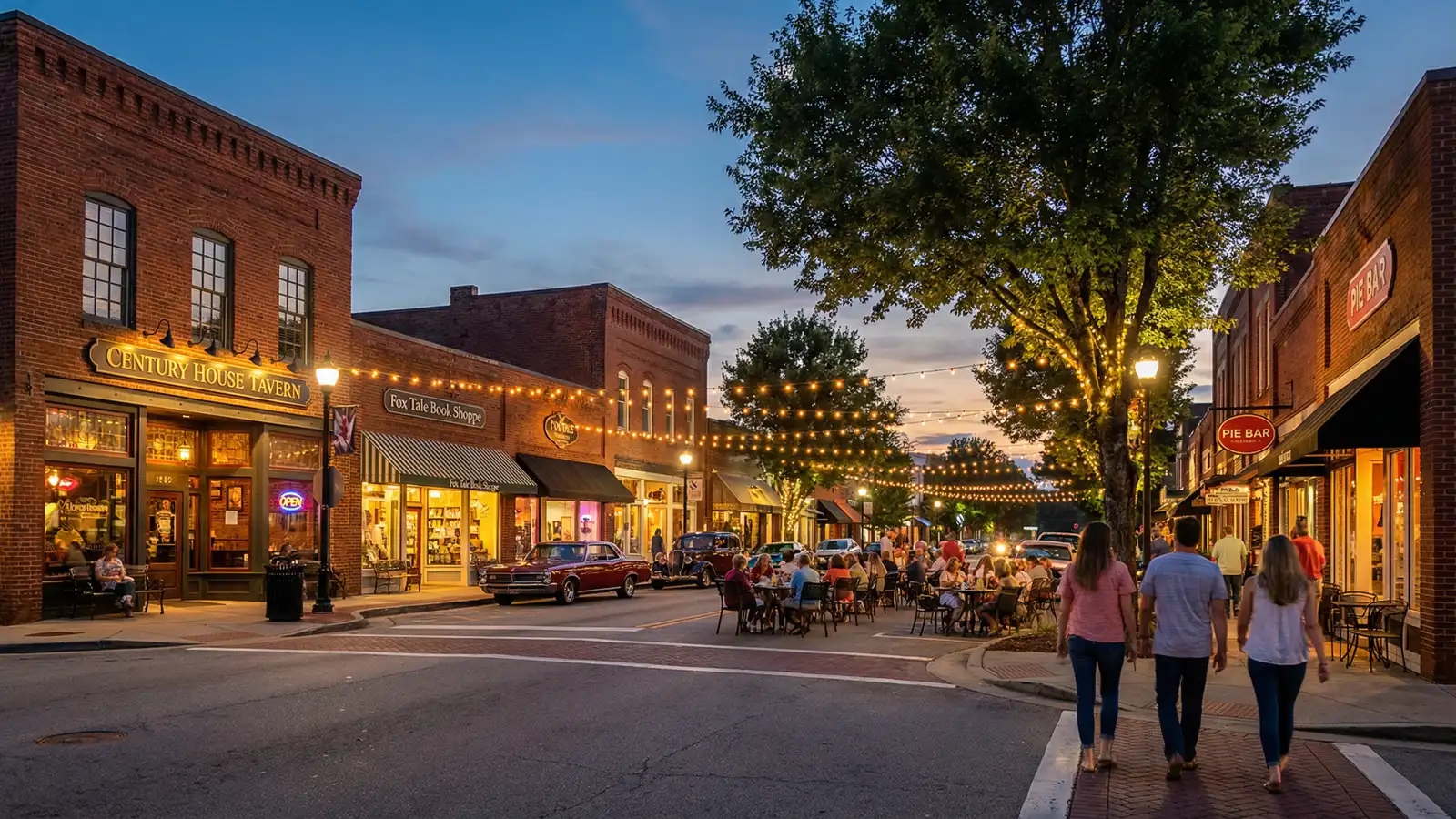
Downtown Woodstock centers on Main Street and Elm Street, a compact grid of shops, restaurants, breweries, and small businesses that has become the city’s defining feature. The district underwent a multi-phase streetscape renovation between 2018 and 2022 that widened sidewalks, added street trees and lighting, created outdoor dining spaces, and installed public art.
The restaurant lineup reflects Woodstock’s personality. Freight Kitchen and Tap occupies a converted rail depot and serves Southern-influenced American cuisine. Reformation Brewery, one of Cherokee County’s first craft breweries, anchors the Elm Street corridor. Campania, an Italian restaurant with a wood-fired pizza oven visible from the dining room, draws a weekend crowd from across the north metro. Rootstock and Vine offers a wine bar with a rotating small-plates menu. The mix is intentionally independent. No national chains in the downtown core.
Saturday mornings at the Woodstock Farmers Market (held at the Woodstock Amphitheater) draw 1,500+ visitors weekly during the season. The amphitheater also hosts a concert series, movies on the green, and holiday events that pull from across Cherokee County.
I walked downtown Woodstock on a Thursday evening last October with a buyer couple who had been living in a Buckhead high-rise. They counted 14 people sitting on restaurant patios along Elm Street, two couples walking dogs, and a family with strollers heading toward the amphitheater. “This feels like a real town,” one of them said. That reaction is common. Downtown Woodstock has authenticity that planned developments cannot replicate because the bones of the district are actual historic buildings (some dating to the early 1900s) repurposed for modern use.
New construction communities in Woodstock
Woodstock and the immediately surrounding unincorporated Cherokee County area contain one of the largest concentrations of active new construction communities in metro Atlanta. The I-575 corridor from Towne Lake Parkway north to Ridgewalk Parkway is bracketed by communities at multiple price points and from multiple builder tiers.

Active new construction by price range
Entry-level new construction in the Woodstock area starts in the mid-$300s for townhomes from builders like Smith Douglas Homes and Meritage Homes. These communities target first-time buyers and investors looking for Cherokee County’s lower property tax rates and newer housing stock.
The volume segment runs from $400K to $600K, where production builders (Pulte, Lennar, DR Horton, Ashton Woods, David Weekley) offer three-to-five-bedroom single-family homes on quarter-acre to half-acre lots. This is the price range where Woodstock’s value proposition is clearest. A four-bedroom, 2,800-square-foot new construction home at $475K in Woodstock would cost $625K+ for a comparable build in Alpharetta and $575K+ in Roswell.
Above $600K, Woodstock’s new construction thins out. A few semi-custom communities offer larger homes on bigger lots in the $650K to $850K range, but buyers at that price point are also shopping Milton, Alpharetta, and east Cobb. Woodstock’s competitive advantage is strongest in the $350K to $600K range.
I track absorption rates across every active community in our Cherokee County coverage area. The communities with the fastest sales velocity in 2025 were those priced between $430K and $530K with builder incentive packages that included rate buydowns. One community off Rope Mill Road moved 47 homes between March and September, averaging 7.8 contracts per month. That absorption rate exceeds most Alpharetta communities in the same period.
For a complete walkthrough of the buying process for new construction in metro Atlanta, the pillar guide covers builder selection, contracts, inspections, and incentive negotiation.
Cherokee County schools serving Woodstock
Woodstock falls within the Cherokee County School District, which serves approximately 43,000 students across 42 schools. Cherokee County Schools has improved significantly over the past decade, with district-wide SAT averages climbing 45 points between 2018 and 2025 and graduation rates exceeding 92%.
The primary high schools serving Woodstock residents are Woodstock High School and Etowah High School. Woodstock High School (enrollment approximately 2,400) offers a comprehensive academic program with 20+ AP courses, a career technical education pathway in healthcare and engineering, and competitive athletics programs. Etowah High School (enrollment approximately 2,300) sits on the south side of Woodstock and feeds from Dean Rusk Middle School and several south-end elementary schools.
Both schools carry GreatSchools ratings of 7/10, which places them in the above-average tier. They do not match the 9/10 and 10/10 ratings that Cambridge (Milton/Alpharetta) and Alpharetta High School hold, and that gap is reflected in the pricing difference between Cherokee and north Fulton.
What the ratings do not capture: Cherokee County Schools has invested heavily in career readiness, dual enrollment with Chattahoochee Tech and Reinhardt University, and STEM programming at the middle school level. For families whose educational priority is career preparation alongside academics (rather than maximizing AP course count), Cherokee County offers a strong fit.
For a complete comparison of school districts across north Atlanta suburbs, the supporting article includes test score data, program inventories, and feeder pattern maps.
Commute from Woodstock to Atlanta and north metro job centers
The commute is the question every Woodstock buyer asks. The answer depends entirely on where you work.
I-575 commute realities
I-575 runs north-south through Woodstock and merges with I-75 at the I-75/I-575 interchange near the Town Center/Kennesaw area. From Woodstock’s central neighborhoods:
To Marietta/Town Center area: 15 to 20 minutes, minimal congestion.
To the Perimeter business district (Dunwoody/Sandy Springs): 30 minutes off-peak, 45 to 60 minutes during morning rush.
To Midtown Atlanta: 35 minutes off-peak, 50 to 70 minutes during morning rush.
To Buckhead: 30 minutes off-peak, 45 to 60 minutes during morning rush.
To Alpharetta (via I-575 to I-75 to I-285 to GA-400, or via surface roads through Milton): 25 to 35 minutes depending on route and time of day.
The morning rush bottleneck is the I-575/I-75 merge. Traffic backs up on I-575 south starting around 6:45 a.m. and clears by 9:00 a.m. most weekdays. The evening return follows the reverse pattern, with I-575 north congestion peaking between 4:30 and 6:30 p.m.
The Cobb County express lane system does not extend to I-575, so there is no toll-based bypass option for the I-575 corridor. This is a genuine disadvantage compared to the GA-400 express lanes available to Alpharetta and Roswell commuters.
Who the Woodstock commute works for
Woodstock’s commute profile works best for buyers who work in the Marietta/Kennesaw corridor, the northwest metro area, or who have hybrid/remote schedules that limit the I-575 commute to two or three days per week. It also works for buyers who work along I-75 between Marietta and Midtown, since I-575 feeds directly into I-75.
The commute is harder for buyers who work in Perimeter, Buckhead, or along the GA-400 corridor (Alpharetta’s employment centers). Those commuters face I-575 to I-75 to I-285 to GA-400, a route with multiple merge points and variable congestion. If your office is in the GA-400 corridor, Alpharetta or Roswell shortens the commute by 15 to 25 minutes each way.
A detailed commute analysis from north Atlanta suburbs to major employment centers covers every major route with time estimates and cost comparisons.
Outdoor recreation and parks
Woodstock’s outdoor infrastructure is one of its underappreciated advantages. The Etowah River runs along the western edge of the city, and Rope Mill Park provides river access, mountain bike trails, and kayak/canoe launch points. Rope Mill Park alone covers 750+ acres and contains over 10 miles of trails ranging from beginner-friendly greenway paths to intermediate singletrack.

The Noonday Creek Trail, a paved multi-use path, runs approximately 7.5 miles through Woodstock, connecting neighborhoods to parks, schools, and commercial areas. The trail is Woodstock’s version of the Big Creek Greenway (Alpharetta) or the Chattahoochee Nature Center trails (Roswell), and expansion plans will extend it to connect with the broader Cherokee County trail network.
Olde Rope Mill Park, Hobgood Park, and Dupree Park add additional green space, athletic fields, and playground facilities. The combined park acreage serving Woodstock residents exceeds 1,200 acres, which is significant for a city of 35,000.
For a family that moved from a dense Atlanta neighborhood last year, I remember the wife telling me that their kids had been to Rope Mill Park four weekends in a row. “They didn’t ask for screen time once,” she said. The outdoor access in Woodstock changes family routines in ways the listing photos do not convey.
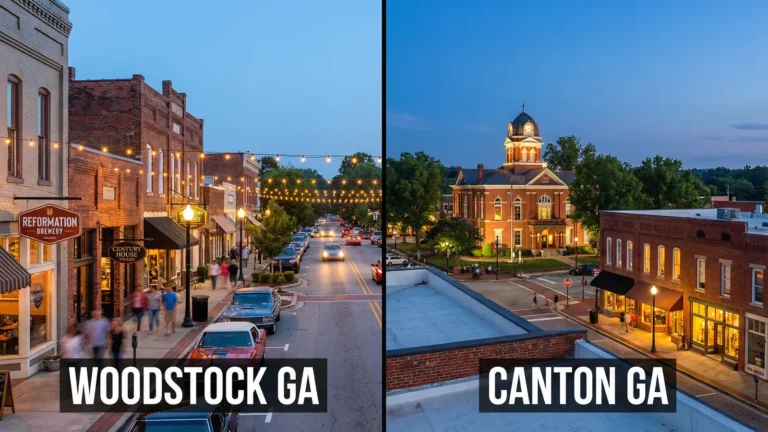
Woodstock vs. Canton: how they compare
Buyers shopping the I-575 corridor inevitably compare Woodstock and Canton. The two cities sit 15 minutes apart on I-575 and share the Cherokee County School District, but they differ in price point, lifestyle, and development stage.
Woodstock is further along in its commercial and residential maturation. Downtown Woodstock is more developed, the restaurant scene is deeper, and the city’s infrastructure (trails, parks, streetscaping) is more polished. Canton is earlier in its growth cycle, with a lower median price ($375K vs. Woodstock’s $420K), larger available lots, and a downtown that is just beginning to attract the kind of independent business investment that Woodstock saw five to eight years ago.
The decision between the two usually comes down to budget and commute tolerance. Buyers who can spend $400K to $550K and want an established downtown scene choose Woodstock. Buyers who want more house and more land for $350K to $450K and are comfortable with a longer commute choose Canton.
The full Woodstock vs. Canton comparison covers pricing, schools, lot sizes, new construction options, and lifestyle differences side by side.
Woodstock real estate market data (2026)
Woodstock’s real estate market in 2026 reflects sustained demand driven by the north-to-south migration of buyers priced out of north Fulton County.

Median home price (all property types, 2025 closings): $420K
Median new construction price: $485K
Average days on market: 21 days (down from 28 in 2024)
Price per square foot (new construction): $165 to $195
Property tax millage rate (Cherokee County, Woodstock city): approximately 28 mills (lower than Fulton County’s 35+ mills)
New construction communities actively selling (within 5-mile radius of downtown): 12+
The pricing trend is consistent: 7% to 9% annual appreciation over the past three years, driven by the combination of new construction absorption and the ongoing migration of north Fulton buyers seeking value. The question is how long that pace sustains. Cherokee County’s new construction pipeline is large, and if builder inventory outpaces buyer demand, the market could shift toward equilibrium faster in Woodstock than in supply-constrained markets like Milton.
For a deeper analysis of the Woodstock market including absorption data and builder trends, the supporting article covers quarterly data and pricing trajectories.
Who Woodstock is best for
Woodstock works for buyers in the $350K to $600K range who want new construction, a walkable downtown with character, Cherokee County’s lower property tax rates, and access to outdoor recreation. It is the strongest option in metro Atlanta for buyers who want the lifestyle quality of a Roswell or Alpharetta at a price point that is $100K to $200K lower.
Woodstock is a particularly strong fit for young families buying their first single-family home, remote workers who value home and community environment over commute optimization, and buyers relocating from higher-cost markets (northeast, west coast, south Florida) who want metro Atlanta’s quality of life without north Fulton’s price premium.
Woodstock is less ideal for buyers who need a short commute to the GA-400 corridor (Alpharetta, Perimeter), buyers who want lots larger than half an acre (Canton offers more land), or buyers in the luxury segment above $800K (limited inventory at that price point in the Woodstock area).
To see how Woodstock compares across every metric, the north Atlanta suburbs comparison guide evaluates all major suburbs side by side.
Download the Woodstock relocation guide
The Velocity Woodstock Relocation Guide is a 10-page resource for families evaluating a move to Woodstock. Inside:
- Woodstock neighborhood map with school zone boundaries
- Cherokee County property tax calculator
- New construction community directory with pricing and builder information
- Commute time chart (Woodstock to major employment centers)
- Downtown Woodstock dining and shopping guide
- Parks and trails map with mileage and difficulty ratings
- Cost of living comparison (Woodstock vs. Roswell, Alpharetta, Canton)
Enter your name and email to download the guide.
[Download the Woodstock Relocation Guide]
Woodstock’s next chapter
Three developments will shape Woodstock’s trajectory over the next two to three years. First, the continued buildout of the Noonday Creek Trail system, which will eventually connect to trails in neighboring cities and create a continuous network exceeding 20 miles. Second, the expansion of downtown Woodstock’s commercial district east along Arnold Mill Road, where several new restaurant and retail concepts have signed leases for 2026 openings. Third, the completion of three large new construction communities along the I-575 corridor north of Woodstock that will add 600+ homes to the local inventory between 2026 and 2028.
That inventory addition is the variable to watch. If absorption keeps pace with supply (and the 2025 data suggests it will), pricing continues its upward trajectory. If rates spike or the economy softens and absorption slows, Woodstock’s market could see temporary price stabilization. Either way, the structural improvements to the city (downtown, trails, parks, schools) are permanent, and those improvements drive long-term value.
Schedule a consultation with Velocity Real Estate to discuss Woodstock’s current market. We track every active community, builder incentive, and pricing shift in Cherokee County. Call 678-278-9798 or book online.
—
Written by Itanza Johnson, Managing Broker at Velocity Real Estate. Georgia Tech industrial engineering graduate. Former Division Sales Manager at John Wieland Homes and VP of Sales and Marketing at Stonecrest Homes. $600M+ in cumulative residential sales across metro Atlanta.
Thinking about buying or selling in metro Atlanta?
Velocity Real Estate has closed more than $600M in new construction and resale across 19 metro Atlanta neighborhoods. Start with a conversation, not a commitment.
Book a consultationCall 678-278-9798