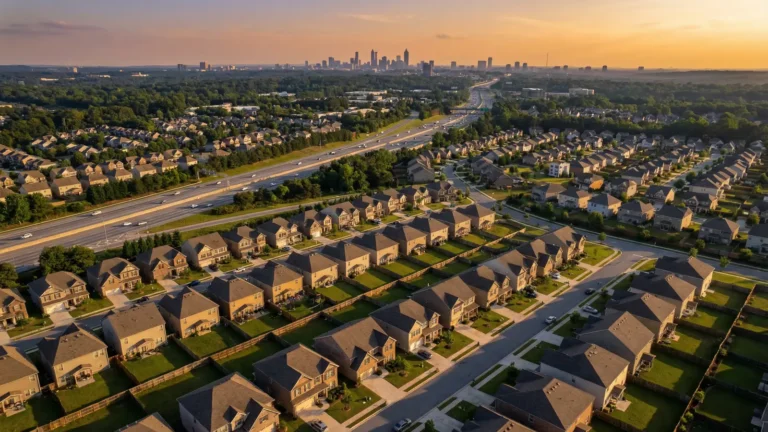
Appreciation trends by Atlanta submarket

Appreciation trends by Atlanta submarket
A client asked me last spring to compare two homes she was considering: one in Alpharetta at $545,000, one in Canton at $425,000. She wanted to know which would be worth more in five years. Not which one she’d enjoy more (she liked both), but which one would build more wealth. I pulled the appreciation trends for both Atlanta submarkets going back to 2019 and the answer surprised her.
Canton’s home, purchased at $120,000 less, was projected to close the gap to within $40,000 by 2030 based on five-year compounded appreciation rates. She bought the Canton home. Her equity position after 11 months is already $38,000 ahead of where the Alpharetta home would have been, adjusted for the higher down payment she would have needed.
Appreciation trends by Atlanta submarket don’t follow a single metro-wide pattern. Each corridor, each county, each city has its own growth rate driven by a specific combination of employment centers, school ratings, infrastructure investment, and builder activity. Knowing which factors are driving appreciation in each submarket is the difference between building $150,000 in equity over a decade and building $250,000.
The five-year view: 2020 to 2025
The five-year period from 2020 to 2025 was the most dynamic stretch in metro Atlanta real estate history. Pandemic-era migration, remote work adoption, and historically low interest rates compressed a decade of appreciation into three years (2020-2023), followed by a normalization period (2023-2025) where rate-sensitive submarkets cooled and fundamentally strong ones held their gains.
South Forsyth County led the metro with 45-52% total appreciation over the five-year period. The median home price in Cumming (30041) went from $365,000 in January 2020 to approximately $555,000 by December 2025. The drivers: Forsyth County’s school system (consistently ranked top three in Georgia), the expansion of GA-400 commercial development between exits 12 and 14, and builder activity from Toll Brothers, Ashton Woods, and David Weekley that brought high-end product to the market and lifted the entire submarket’s pricing floor.
Cherokee County (Canton, Woodstock, Holly Springs) was close behind at 42-51%. Canton in particular outperformed expectations because of two factors most buyers overlook. First, the Reinhardt University corridor attracted mixed-use development that added retail and dining density. Second, Cherokee County schools improved from “good” to “excellent” in GreatSchools ratings during this period, which directly correlates with home values in suburban markets.
North Fulton (Alpharetta, Milton, Johns Creek) appreciated 38-44%. Strong in absolute dollars but lower as a percentage because the starting price point was already elevated. A 40% gain on a $550,000 home ($220,000) versus a 48% gain on a $375,000 home ($180,000) illustrates the math: higher percentage gains on lower-priced homes can still produce fewer absolute dollars, but the return on the down payment investment is significantly better in the lower-priced submarket.
Gwinnett County showed the widest internal variation. West Gwinnett (Peachtree Corners, Duluth, Suwanee) appreciated 35-42%, tracking close to north Fulton. East Gwinnett (Dacula, Buford, Lawrenceville) ran 28-36%, with the lower end concentrated in the I-85 corridor south of I-985. The split tracks closely with school district ratings and proximity to employment centers.
The one-year snapshot: 2025
The most recent 12-month data (through Q4 2025) reveals a different hierarchy than the five-year numbers.

South Forsyth County: 5.1% year-over-year. Still leading, driven by limited resale inventory and continued in-migration from Fulton County families priced out of north Fulton’s $600,000+ market.
Cherokee County: 4.6% year-over-year. Canton’s appreciation slowed slightly from its 2021-2023 pace but remains above the metro average. New construction absorption is strong at 2.8 homes per month across the county’s 12 largest communities.
East Gwinnett (Dacula, Buford): 4.3% year-over-year. This is the emerging story. Dacula’s median price crossed $400,000 for the first time in Q3 2025. The completion of the I-85 widening project through Gwinnett and the expansion of commercial development around Hamilton Mill are pulling demand into an area that was considered “too far out” five years ago.
North Fulton: 3.8% year-over-year. Alpharetta and Johns Creek are appreciating at a slower rate because the price ceiling is compressing demand. Buyers who would have purchased at $650,000 in Alpharetta are instead looking at $480,000 options in Cumming or $420,000 options in Canton. Milton is the exception within north Fulton, running at 4.4%, because its large-lot zoning limits new inventory and creates scarcity.
Sandy Springs: 3.2% year-over-year. The condo and townhome market in the Perimeter Center area is dragging down the single-family numbers. Single-family detached homes in Sandy Springs’ established neighborhoods (Heards Ferry, Spalding Drive area) are appreciating closer to 4.0%.
What drives appreciation at the submarket level
I’ve been tracking appreciation drivers across metro Atlanta since my days at John Wieland Homes, where community pricing was my daily work. The factors that predict appreciation over three-to-five-year windows, ranked by impact:

Employment center proximity. Submarkets within a 20-minute commute of major employment hubs appreciate 1.2-1.8% faster than comparable communities 30+ minutes from the same employers. The GA-400 corridor (Alpharetta, Roswell, Sandy Springs) benefits from proximity to the Windward/Northpoint tech cluster and the Perimeter Center business district. The I-85 corridor in Gwinnett benefits from the logistics and distribution sector centered around Sugarloaf and Jimmy Carter Boulevard.
School district quality. Every one-point increase in a GreatSchools district rating correlates with approximately 2.5% higher home values in suburban Atlanta. When Cherokee County schools moved from a 7/10 composite to an 8/10 composite between 2019 and 2023, it added measurable pricing power to every community in the county.
New construction pipeline activity. This one surprises people. Submarkets with active builder investment appreciate faster than submarkets without it. The conventional assumption is that new construction adds supply and dampens prices. But builders perform extensive market analysis before committing $20M-$50M to a community development. Their presence signals that professional underwriters believe the submarket will support price growth. When Toll Brothers, Ashton Woods, and Pulte all develop in the same corridor, the combined marketing, model home investment, and sales activity raises the profile of the entire area.
I saw this play out in Holly Springs between 2019 and 2023. Three national builders broke ground within 18 months. Each raised base prices 3-5% per quarter as phases absorbed. The existing resale homes within a two-mile radius appreciated 8-12% per year during the same period, pulled along by the rising tide of new construction pricing.
Infrastructure investment. Road widenings, MARTA extensions, park development, and mixed-use projects all create appreciation. The construction of the Big Creek Greenway extension through Alpharetta and Roswell added measurable value to homes within a half-mile of trail access points. The GA-400 express lanes project, completed in stages from 2020 to 2024, reduced commute times from Forsyth County to Buckhead by 15-20 minutes and accelerated Forsyth’s appreciation rate.
Which submarkets are peaking, which are emerging
No submarket appreciates at 6-8% forever. The cycle moves through four phases: emerging (2-3% annual appreciation, building momentum), accelerating (4-6%, active builder entry, rising demand), peak growth (6-8%, supply constraints, media attention), and normalization (3-4%, mature market, steady returns).
Peaking: south Forsyth County. The five-year run has been extraordinary, but the rate of appreciation is decelerating. Median prices above $550,000 are approaching the ceiling where buyer demand shifts to lower-cost alternatives. Forsyth will remain a strong market, but the 8-10% years are behind it.
Accelerating: Cherokee County (Canton, Holly Springs), Dacula/Buford in east Gwinnett. These areas are in the sweet spot where employment growth, school quality improvements, and builder investment are all compounding simultaneously. Canton has room to run because its median price ($425,000) is still $130,000 below south Forsyth.
Emerging: Tucker, parts of south DeKalb, and the Peachtree City/Fayetteville corridor in south metro. These are early-stage appreciation plays. Tucker benefits from Emory/CDC proximity and relatively affordable pricing ($380,000-$450,000 for single-family). Peachtree City has always been a premium market but is now attracting Atlanta commuters who can work remotely three days a week.
Steady: north Fulton (Alpharetta, Johns Creek, Roswell). These are mature markets that will deliver 3-4% annual appreciation with low volatility. They’re wealth preservation markets, not growth markets. The right choice for someone prioritizing stability and school quality over maximum appreciation.
For a comprehensive view of how appreciation fits into a total wealth-building strategy (including leverage, tax advantages, and rental income), read the real estate wealth building in Atlanta pillar article.
Download: Atlanta submarket appreciation report
The Velocity Real Estate Atlanta Submarket Appreciation Report is a 6-page document with five-year and one-year appreciation data for 12 metro Atlanta submarkets, a breakdown of the factors driving each market’s performance, a forward-looking assessment of which markets are emerging, accelerating, and peaking, and a worksheet where you can map your target purchase price against projected appreciation over three, five, and ten-year horizons.
Enter your name and email to download the report.
[Download the Atlanta Submarket Appreciation Report]
Trying to decide which submarket gives you the best return on your next purchase? Schedule a consultation or call 678-809-5860. I’ll pull the latest FMLS data for your target areas and walk you through the appreciation projections.
—
Written by Itanza Johnson, Managing Broker at Velocity Real Estate. Georgia Tech industrial engineering graduate. Former Division Sales Manager at John Wieland Homes and VP of Sales and Marketing at Stonecrest Homes. $600M+ in cumulative residential sales across metro Atlanta.
Thinking about buying or selling in metro Atlanta?
Velocity Real Estate has closed more than $600M in new construction and resale across 19 metro Atlanta neighborhoods. Start with a conversation, not a commitment.
Book a consultationCall 678-278-9798