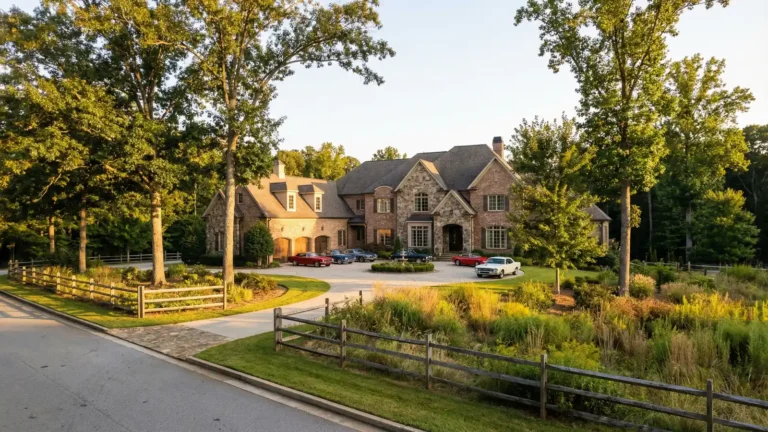
Alpharetta vs. Milton: which city fits you?

Alpharetta vs. Milton: which city fits you?
If you’re comparing Alpharetta vs Milton GA, you’re already looking at two of the strongest residential markets in north Fulton County. Both cities draw families relocating from out of state, move-up buyers leaving Roswell or Johns Creek, and executives who want a short drive to the Avalon or Windward office corridors. The differences between these two cities are real, but they’re not what most online guides tell you.
I’ve sold homes in both cities for over 15 years. The buyers who end up happiest are the ones who understand what daily life actually looks like in each place, not just the median price on Zillow.
This article breaks down schools, pricing, new construction inventory, walkability, commute times, property taxes, and HOA costs so you can make a decision grounded in specifics. For a broader look at how these two cities fit into the full north Atlanta picture, read our north Atlanta suburbs comparison guide.
The decision you’re actually making
Alpharetta and Milton share a school system, a ZIP code prefix, and a stretch of GA-400. But the lifestyles are different enough that picking the wrong one means you’ll notice it every week.
Alpharetta gives you proximity. Restaurants, retail, Avalon, downtown Alpharetta’s restaurant row on Milton Avenue, and a sidewalk network that connects neighborhoods to commercial districts. You can walk to dinner. You can bike to the farmers market on Saturday mornings. Your teenagers can drive to a movie theater in eight minutes.
Milton gives you acreage. Horse farms. Two-lane roads lined with hardwoods. The quiet that comes with a city that intentionally limits commercial density. Milton incorporated in 2006 specifically to control development, and that mandate still shapes the zoning code. If your priority is land, privacy, and a rural feel 30 minutes from Buckhead, Milton delivers that in a way Alpharetta cannot.
The question is which tradeoff fits your family’s actual routines.
School zones in Fulton County
Both cities feed into the Fulton County Schools system, but the school assignments differ by neighborhood.
Alpharetta elementary zones include Alpharetta Elementary, Cogburn Woods, Creek View, Manning Oaks, and New Prospect. Milton elementary zones include Birmingham Falls, Crabapple Crossing, and Summit Hill. At the middle school level, Alpharetta neighborhoods feed into Hopewell Middle and Northwestern Middle, while Milton neighborhoods primarily feed into Northwestern Middle and Piney Grove Middle.
High school is where the conversation gets specific. Alpharetta High School and Milton High School both rank in the top 15% of Georgia public high schools by GreatSchools ratings. Cambridge High School, which opened in 2017, pulls students from parts of both cities and has quickly built a reputation for its STEM and AP programming. SAT averages at all three schools run 50 to 80 points above the state mean.
One factor most buyers overlook: Milton’s lower population density means smaller neighborhood feeder pools. Class sizes at Birmingham Falls and Crabapple Crossing elementary schools have consistently run smaller than the Fulton County average over the past three years. If class size matters to your family (and after about 400 conversations with relocating parents, I can tell you it usually does), pull the specific enrollment numbers for the schools zoned to the neighborhoods you’re considering.
Home prices and what drives the gap
Here’s where the numbers tell a story that surprises most buyers.
| Category | Alpharetta | Milton |
|---|---|---|
| Median sale price (2025) | $525,000 | $765,000 |
| Median price per sq ft | $215 | $233 |
| Average lot size | 0.25 acres | 0.85 acres |
| Typical new construction price | $550,000 to $850,000 | $750,000 to $1.4M |
| Days on market (avg) | 18 | 24 |
| Inventory (active listings, Q4 2025) | 142 | 87 |
The headline gap between $525K and $765K looks enormous. But the per-square-foot difference is only about $18. Milton’s higher median is driven almost entirely by lot size. You’re buying more land, not necessarily a more expensive house.
I had a buyer last spring who was convinced she couldn’t afford Milton. Her budget was $700K. We pulled the FMLS data and found 11 active listings in Milton under $700K, most of them on lots between 0.5 and 0.75 acres. She’d been filtering by median price and assumed everything in Milton started at $800K. It doesn’t. The inventory is thinner, which is why the search takes longer, but the options exist if you know where to look.
New construction availability
Alpharetta’s new construction pipeline runs deeper than Milton’s. Builders like Toll Brothers, Ashton Woods, and David Weekley have active communities in Alpharetta with lot counts ranging from 40 to 180 homes per community. Base prices start in the low $500s for townhomes and climb past $900K for single-family detached on quarter-acre lots.

Milton’s zoning restrictions limit subdivision density. Most new construction in Milton comes through custom builders on individual lots or small infill communities of 15 to 30 homes. Builders like Brock Built, Peachtree Residential, and several boutique custom builders operate in Milton, but you won’t find the 150-lot master-planned communities that line Old Milton Parkway on the Alpharetta side.
What this means for buyers: if you want a production builder with a design center, a structured option package, and a model home you can walk through next Saturday, Alpharetta gives you more choices. If you want a custom or semi-custom home on a larger lot and you’re willing to manage a longer construction timeline (typically 10 to 14 months versus 7 to 10 months for production builders), Milton’s land availability makes that feasible.
Downtown walkability versus rural character
This is the lifestyle fork.
Downtown Alpharetta has a walkable core centered on Milton Avenue and Main Street. The weekend farmers market runs April through October. Restaurants like Bocca Lupo, South Main Kitchen, and Smokejack BBQ are within a two-block stretch. The Alpharetta City Center development added green space, a stage for live events, and mixed-use retail. Avalon sits two miles south with 500,000 square feet of retail, dining, and a movie theater.
Milton has Crabapple. The Crabapple district along Broadwell Road and Birmingham Highway has a handful of restaurants (including the well-known Crabapple Tavern), a small-batch coffee shop, and a weekend market that’s noticeably smaller and quieter than Alpharetta’s. That’s intentional. Milton residents who chose Crabapple chose it because it’s not Avalon.
If your family’s weekend routine involves walking to brunch, browsing shops, and catching an outdoor concert without getting in the car, Alpharetta is designed for that. If your weekend routine involves saddling up a horse, walking your property line, and driving 12 minutes to dinner when you feel like going out, Milton is designed for that.
Commute comparison
Both cities sit along the GA-400 corridor, which is the primary artery to Buckhead (25 to 35 minutes without traffic, 45 to 60 during peak hours) and Midtown (30 to 40 minutes without, 55 to 75 during peak).
The practical difference: Alpharetta neighborhoods closer to GA-400 exits (Old Milton Parkway, Haynes Bridge Road) shave 5 to 10 minutes off the highway access time compared to Milton neighborhoods west of GA-9. If you’re commuting daily to a Buckhead or Midtown office, those 5 to 10 minutes compound. Over 250 working days, that’s 40 to 80 extra hours per year in the car.
Milton buyers who work in the Windward or Avalon office clusters, though, have a reverse advantage. Their commute stays on surface streets and avoids GA-400 entirely. Several Milton neighborhoods sit within a 12-minute drive of the Windward business park along Cogburn Road and Deerfield Parkway.
Know your office location before you choose your city. It changes the math.
Property taxes and HOA fees
Fulton County millage rates apply equally to both cities, but the city millage differs slightly. Milton’s city millage rate has historically run lower than Alpharetta’s (Milton: approximately 4.731 mills; Alpharetta: approximately 5.95 mills as of 2025). On a $600,000 assessed home, that difference works out to roughly $290 per year in city taxes.
HOA fees tell a different story. Alpharetta’s master-planned communities with amenity centers (swim, tennis, clubhouse, walking trails) typically charge $100 to $250 per month. Milton’s smaller communities and equestrian neighborhoods charge $50 to $150 per month, and some Milton properties on individual lots have no HOA at all.
That “no HOA” detail matters to a specific type of buyer. I had a client relocate from a community in Gwinnett County where the HOA fined residents for leaving garbage cans visible from the street past 6 p.m. on collection day. His first requirement for the new house was “no HOA.” We found three options in Milton within his budget. Alpharetta had zero.
How buyers at Velocity Real Estate typically decide
After years of running these comparisons for clients, patterns emerge.
Families with children under 10 who both work in Atlanta proper lean toward Alpharetta. The shorter commute, the after-school activity access, and the walkable weekends win out. Families with teenagers tend to split: the kids want Alpharetta’s social infrastructure, but parents who’ve lived in dense suburbs before sometimes gravitate toward Milton’s space.
Empty nesters and downsizers surprise me. I’d expect them to choose walkability, but about 40% of the empty-nester buyers I’ve worked with in the past three years chose Milton. They want the land. They want the quiet. They’re done with HOA newsletters and neighborhood pool drama. They want a porch, a garden, and acreage between them and the next roofline.
The buyers who struggle most are the ones trying to get both: Milton’s land and Alpharetta’s amenities. That combination exists at the $1.2M+ price point in specific pockets along the Alpharetta-Milton border near Birmingham Highway. Below that price point, you’re choosing one or the other.
Download the suburb comparison worksheet
The Velocity Real Estate Suburb Comparison Worksheet gives you a structured way to evaluate Alpharetta, Milton, and any other north Atlanta city on the criteria that matter to your family. Two pages. Columns for schools, commute time, pricing, lot size, walkability, and HOA costs. Fill it in before your first showing so the conversation starts from data, not assumptions.
[Download the Suburb Comparison Worksheet], name and email required. The worksheet arrives in your inbox within 60 seconds.
Where to go from here
If Alpharetta is pulling ahead in your comparison, read our guide to living in Alpharetta for neighborhood-level detail on school zones, pricing by subdivision, and new construction communities. If Milton is the frontrunner, our living in Milton guide covers Crabapple, Birmingham Crossroads, and the equestrian corridor.
Schools are often the tipping point. Our breakdown of the best school districts in north Atlanta maps feeder patterns to specific new construction communities across both cities.
For a side-by-side look at all the suburbs in the north Atlanta corridor, start with the north Atlanta suburbs comparison guide.
Schedule a consultation at 678-278-9798 to walk through the comparison with your specific budget, commute, and family priorities on the table.
—
Written by Itanza Johnson, Managing Broker at Velocity Real Estate. Georgia Tech industrial engineering graduate. Former Division Sales Manager at John Wieland Homes and VP of Sales and Marketing at Stonecrest Homes. $600M+ in cumulative residential sales across metro Atlanta.
Thinking about buying or selling in metro Atlanta?
Velocity Real Estate has closed more than $600M in new construction and resale across 19 metro Atlanta neighborhoods. Start with a conversation, not a commitment.
Book a consultationCall 678-278-9798