

How to research home builder complaints in Georgia

How to research home builder complaints in Georgia
You found a floor plan you love in a community that checks every box. The sales center is polished, the model home is beautiful, and the onsite agent is telling you about a closing cost incentive that expires Friday. Before you sign anything, you need to research home builder complaints in Georgia. Every builder in this market has complaints filed somewhere. The question is what kind, how many, and how the builder responded.
I’ve been on the builder side of this equation. As a Division Sales Manager at John Wieland Homes and VP of Sales and Marketing at Stonecrest Homes, I saw how complaints were handled internally. Some builders treated every complaint as a problem to resolve. Others treated them as noise to minimize. The difference shows up in the public record if you know where to look.
This is the exact research process I walk buyers through before they sign a new construction contract in metro Atlanta. For a full list of who’s building where and at what price, start with the biggest builders in Atlanta and the Atlanta home builders guide.
What you need before you start
Gather three pieces of information: the builder’s full legal entity name (which may differ from their marketing name), the community address or county, and the name of the builder’s Georgia registered agent. The legal entity name appears on the purchase agreement. If you haven’t received a contract yet, ask the onsite sales agent for the builder’s full corporate name. You’ll need it for every database search below.
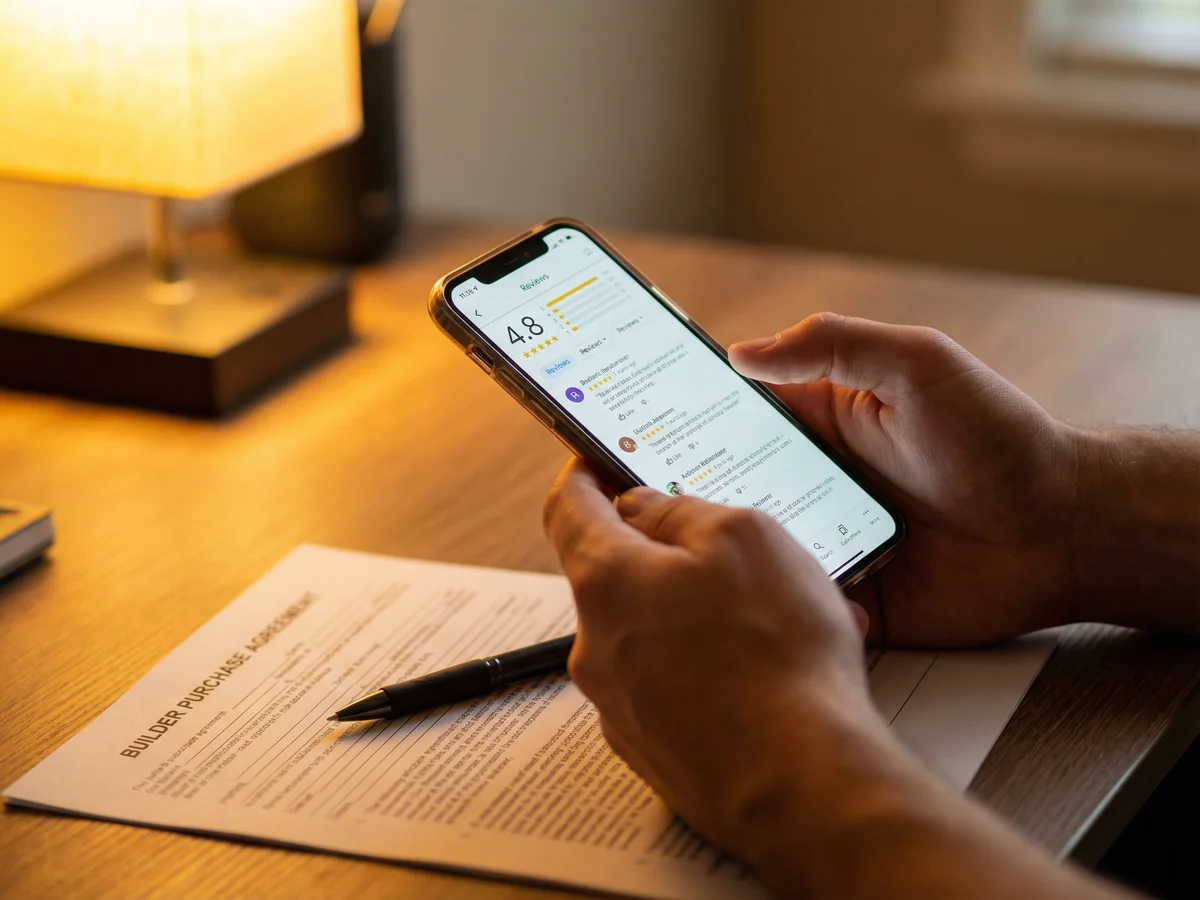
Set aside about 90 minutes. This is a one-time investment that protects a six-figure purchase.
Step 1: check the Better Business Bureau
Go to bbb.org and search the builder’s name with “Atlanta, GA” as the location. The BBB profile shows three things worth your attention: the letter rating, the complaint count over the past three years, and the complaint resolution history.
The letter rating matters less than the complaint detail. A builder with 200 complaints and an A+ rating resolved those complaints through the BBB process. That actually tells you something positive about their responsiveness. A builder with 12 complaints and a B- rating may have unresolved disputes, which is a bigger red flag.
Read the actual complaint text. Look for patterns. Are the complaints about cosmetic punch-list items (cracked grout, paint touch-ups, landscaping delays)? Those are normal in new construction. Are the complaints about structural issues, water intrusion, or HVAC failures in the first year? Those are serious. Are multiple complaints describing the same problem in the same community? That points to a systemic construction issue, not a one-off defect.
I had a buyer last year who was ready to contract with a builder in Forsyth County. We pulled the BBB profile and found 11 complaints about the same drainage issue in a single community. Water pooling in backyards, wet crawlspaces after heavy rain, and the builder’s response in each case was “meets code.” The buyer chose a different community. Six months later, the original builder installed a retention pond retrofit. The BBB complaints told the story before the builder acknowledged the problem publicly.
Step 2: verify the Georgia contractor license
Georgia does not require a specific “homebuilder license,” but general contractors must register with the Georgia Secretary of State. Search the Georgia Secretary of State Corporations Division database (ecorp.sos.ga.gov) for the builder’s legal entity. Confirm the entity is in “Active/Compliance” status.
Also search the Georgia Licensing Board for contractors (sos.ga.gov/plb) to check whether the builder or their qualifying agent holds a valid license. If the builder operates as a general contractor, their license number should appear on the purchase agreement or marketing materials. If it doesn’t, ask for it.
This step takes five minutes and confirms the builder is legally authorized to operate in Georgia. A lapsed registration or dissolved entity is a non-starter.
Step 3: search county building permits
Every new construction project requires building permits issued by the county. Go to the building permits or development services section of the county government website where the community is located. Cherokee County, Forsyth County, Fulton County, and Gwinnett County all have online permit search tools.
Search by the builder’s name or the community’s subdivision name. You’re looking for two things: active permits confirming the builder is currently pulling permits in that community, and any stop-work orders or code violation notices. A stop-work order means the county inspector found something serious enough to halt construction. It happens. What matters is how quickly the builder resolved it.
This search also shows you how many lots the builder has permitted versus how many they’ve sold. If a builder permitted 40 lots and only 8 have active construction after 18 months, the absorption pace is slow. Slow absorption communities sometimes see builders cut corners on common area amenities to manage costs.
Step 4: analyze Google reviews (the right way)
Google reviews for builders are messy. National builders accumulate reviews across their corporate profile, their Atlanta division profile, and individual community profiles. Search all three.
Ignore the star rating. Read the one-star and two-star reviews first. Look for construction quality complaints, not sales process complaints. A review complaining about “pushy sales tactics” tells you nothing about the home you’ll live in. A review describing “cracks in the foundation at month six” tells you a lot.
Then read the three-star reviews. These are often the most honest. Buyers who leave three stars are saying “the home is decent, but here’s what went wrong.” Their specifics are useful.
Count how many reviews mention warranty responsiveness. A builder who shows up promptly for warranty claims in the first year is signaling operational competence. A builder whose reviews repeatedly mention “they stopped returning calls after closing” is telling you exactly what to expect.
Step 5: research warranty claim patterns
If the builder uses a third-party warranty company (many do for the structural warranty component), search that company’s name plus the builder’s name. Some third-party warranty providers have their own complaint databases. The two most common in Georgia are 2-10 Home Buyers Warranty and StrucSure Home Warranty.
Ask the builder’s sales agent directly: “How many warranty claims were filed in this community in the past 12 months, and what was the average resolution time?” A confident builder will answer. A builder who deflects that question is giving you information too.
Step 6: ask for homeowner references
This is the step most buyers skip, and it’s the most valuable. Ask the onsite sales agent for the names and contact information of three homeowners who closed at least 12 months ago in the same community. Twelve months is the key number because it gets you past the honeymoon period and into the warranty claim window.
Call them. Ask three questions: What surprised you about the construction quality after you moved in? How responsive was the builder’s warranty team? Would you buy from this builder again?
The answers will tell you more than any database search. Homeowners who have lived through a full year of ownership, through Georgia’s summer storms and winter freezes, know exactly how well their home was built.
For a visual walkthrough of what to look for when you’re actually standing inside a model home or on a construction site, read about the red flags when touring new construction communities.
The research changes the negotiation
Here’s what most buyers don’t realize: doing this research gives you leverage at the contract table. When you sit down with a builder’s sales agent and reference specific BBB complaint resolutions, permit histories, and homeowner feedback, you signal that you’re an informed buyer. Informed buyers get better responses to repair requests, clearer timelines on construction milestones, and more attention during the warranty period.
The research takes 90 minutes. The contract you’re about to sign commits you to $400,000 or more. The math on that time investment is obvious.
If you want help running this analysis or interpreting what you find, schedule a builder consultation. I run this exact research process for every buyer client before we visit the first model home.
—
Download the Builder Research Checklist
A one-page printable checklist covering all six research steps with the specific URLs, search terms, and questions you need. Check each box as you go and bring the completed checklist to your contract review meeting.
Enter your name and email to get the checklist delivered to your inbox.
[Download the Builder Research Checklist]
—
Written by Itanza Johnson, Managing Broker at Velocity Real Estate. Georgia Tech industrial engineering graduate. Former Division Sales Manager at John Wieland Homes and VP of Sales and Marketing at Stonecrest Homes. $600M+ in cumulative residential sales across metro Atlanta.
Thinking about buying or selling in metro Atlanta?
Velocity Real Estate has closed more than $600M in new construction and resale across 19 metro Atlanta neighborhoods. Start with a conversation, not a commitment.
Book a consultationCall 678-278-9798


